

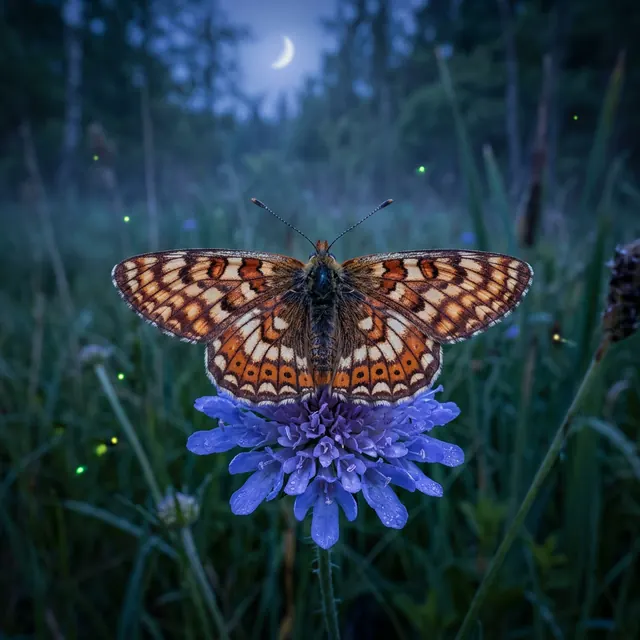
Marsh fritillary
Euphydryas aurinia
A butterfly of damp meadows whose caterpillars in Poland eat only devil's-bit scabious. It has died out at many sites, because meadows became overgrown or were used too intensively. Most of them in Poland live in the Lubelszczyzna region and near Kielce. It is protected throughout the European Union.
How to recognise
- Wingspan 36–40 mm
- Wings in an orange-brown chequered pattern with pale spots
- Male and female look alike
- Young caterpillars live in a group in a shared web
Where it lives
Damp and dry meadows with devil's-bit scabious, extensively mown or grazed.
When you'll see it
One generation a year. Butterflies fly from the end of May to the end of June.
Tracks
Silk webs with a group of caterpillars on devil's-bit scabious, visible from the end of August. Eggs in multi-layered clusters under leaves.
Tracks
Close-up of a communal silk web spun on devil's-bit scabious leaves with dozens of small black spiny caterpillars of the marsh fritillary inside, realistic late summer macro. Realistic nature photograph, no people, no text, square composition.
When you meet it
Do not catch butterflies and do not tear down the webs. Meadows with devil's-bit scabious are harmed both by overgrowth and by too intensive use. An observation of a protected species is worth reporting to the Regional Directorate for Environmental Protection (RDOŚ).
Role in the forest
An indicator of natural meadows. Where it lives, the richness of meadow flowers and insects is preserved.
Fun fact
The caterpillars of the first stages live together in a shared silk web on devil's-bit scabious and overwinter in it. To lay her eggs the female chooses the greenest leaves, with the most chlorophyll, which give the young the best food.