

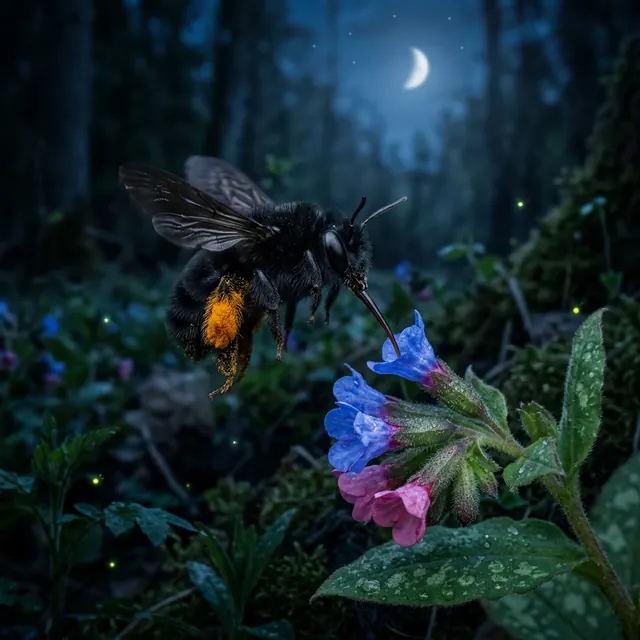
Hairy-footed flower bee
Anthophora plumipes
An early-spring solitary bee, stocky and densely hairy, looking a little like a small bumblebee. It digs nests in banks and clay walls. It is solitary, but nests often lie side by side and form colonies. In Poland it is often encountered.
How to recognise
- Length 13–15 mm, dense fur
- Female black with orange-ginger brushes on the hind legs, sometimes also greyish brown
- Male ginger-brown or grey, with a yellow face
- The male has very long middle legs with plumes of black hairs
Where it lives
Banks, clay and old walls of buildings, gardens, parks and forest edges with spring flowers.
When you'll see it
From March–April to June. One generation a year.
Tracks
Holes in a clay bank or wall, often many side by side. A fast, sharp flight from flower to flower and brief hovering in the air.
Tracks
Close-up of an old clay wall with many round nest holes of solitary bees, a male hairy-footed flower bee with a yellow face and long feathered middle legs resting at one hole, realistic spring light. Realistic nature photograph, no people, no text, square composition.
When you meet it
Calm, do not disturb her at the nests. It is worth leaving the clay walls of old buildings and banks without plaster and concrete. If you have signs of an allergy after a sting, call 112. The species is protected.
Role in the forest
An early pollinator of lungworts, dead-nettles, ground ivy, bugle, comfrey and corydalis. It has been recorded on almost 90 plant species.
Fun fact
The flower bee raises its body temperature by working its muscles, so it takes off in cool weather, like bumblebees. It softens the soil for its nest with water that it brings itself. Clay blocks with holes are put into insect hotels with her in mind.