

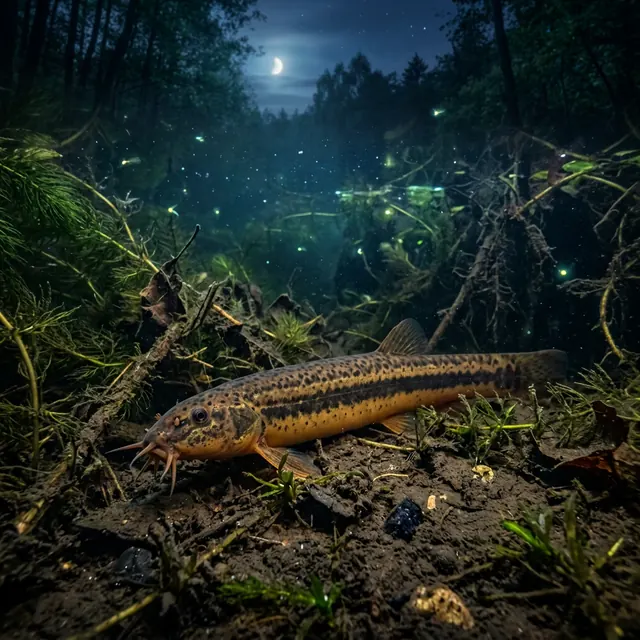
European weatherfish
Misgurnus fossilis
An elongated, snake-like fish with ten barbels around its mouth. It lives in muddy ditches, oxbow lakes and ponds with poorly oxygenated water. When oxygen is lacking, it gulps air at the surface and breathes with it through its intestine.
How to recognise
- up to 30 cm, cylindrical body like an eel
- 10 barbels around the mouth opening
- brown back, yellow or orange belly
- broad dark stripe along the side, edged with thinner stripes
- when taken out of the water it makes a quiet whistle or squeak
Where it lives
Lowland waters. Drainage ditches, canals, oxbow lakes, river branches and ponds with a muddy bottom and still or slow-flowing water.
When you'll see it
Active at night, all year round. Spawning in May and June in flooded shallows.
Tracks
Hard to see. Before a storm it can be visible just under the surface of the water, swimming restlessly up and down.
When you meet it
If you catch a weatherfish, release it immediately, because it is protected. The ditches and oxbow lakes where it lives should not be deepened or filled in.
What the beliefs say
The weatherfish senses the drop in pressure before a storm and then becomes very active, swimming right near the surface. That is why it is called weatherfish in English.
Fun fact
Newly hatched weatherfish larvae have thread-like external gills on the head, like the tadpoles of newts. They disappear after a few days, when the fry begin to feed on their own.