

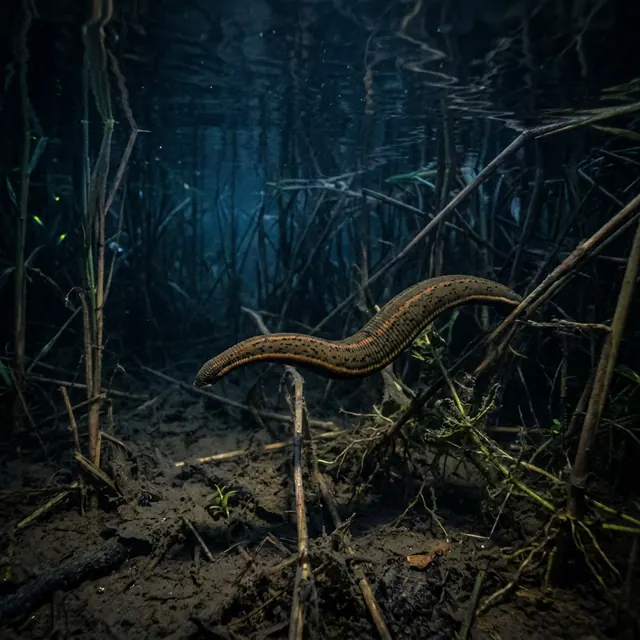
Medicinal leech
Hirudo medicinalis
The most famous leech native to Poland. A parasite that feeds on the blood of vertebrates, mainly amphibians. Its saliva contains hirudin, which keeps blood from clotting, and an anaesthetic substance, which is why the bite is painless. In many places it has been wiped out by overcollecting and loss of habitat.
How to recognise
- Length 10–15 cm, flattened
- Back dark brown to black with six rusty-brown stripes
- Belly covered with spots
- Body of 33–34 segments, a round sucker around the mouth opening
Where it lives
Shallow, small bodies of still or slow-flowing water with a muddy bottom and reeds. A heat-loving species.
When you'll see it
In the warm season. It can survive without food for up to two years.
Tracks
Cocoons with eggs laid in damp soil on the edge of the water body.
Tracks
Close-up of the round front sucker of a medicinal leech pressed against wet glass, showing the small circular mouth opening, realistic macro. Realistic nature photograph, no people, no text, square composition.
When you meet it
A leech drops off by itself once it has fed. The small wound may then bleed for longer, and later itch and swell. Wash it and keep an eye on it. Do not catch leeches and do not use wild specimens for treatments, because they can carry diseases and parasites. The species is protected.
Role in the forest
A parasite of amphibians, mammals and reptiles, part of the food web of small water bodies. Its presence shows that overgrown ponds have been preserved.
What the beliefs say
Since antiquity it was believed that bloodletting with leeches cured many diseases. Leeches were applied, among other things, for high blood pressure. In the mid-19th century this custom gave way to modern medicine and pharmacology.
Fun fact
In one sitting it sucks 10–15 ml of blood and may increase its body weight up to 5 times. It stores the blood in 10 lateral pouches of the gut. Since the 1970s, leeches bred in sterile conditions have returned to hospitals: in microsurgery they help drain congested blood, for example after a finger has been sewn back on.