

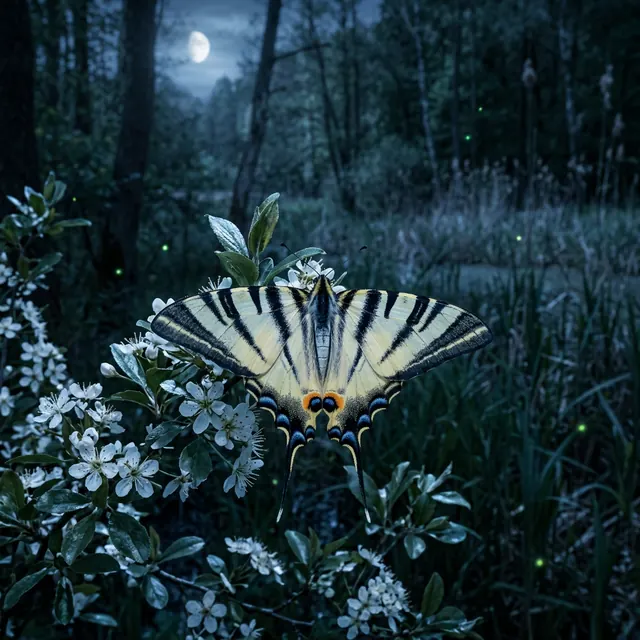
Scarce swallowtail
Iphiclides podalirius
A large day-flying butterfly with pale yellow wings with black stripes and long tails on the hindwings. Rarer than the Old World swallowtail. In Poland it lives mainly in the south and the middle of the country. It likes rocky outcrops, sunlit hills, glades and orchards.
How to recognise
- Wingspan 70–80 mm
- Pale yellow wings with transverse black stripes
- Blue half-moons and an orange spot on the hindwings
- Long tails on the hindwings
Where it lives
Warm rocky outcrops, grasslands, sunlit slopes, glades and orchards with blackthorn. Southern and central Poland, including the Carpathian national parks.
When you'll see it
First generation from May to early July, the second, if it appears, from early August.
Tracks
On leaves of blackthorn and fruit trees, a green caterpillar with yellow stripes and red dots. It turns yellow before pupating.
Tracks
Close-up of a green scarce swallowtail caterpillar with thin yellow lines and small red dots on a blackthorn leaf, realistic macro. Realistic nature photograph, no people, no text, square composition.
When you meet it
Do not catch the butterfly, it is protected. Leave blackthorn bushes and wild plums in the garden.
Role in the forest
A pollinator of flowers of warm grasslands and orchards.
What the beliefs say
The Latin name comes from two figures of Greek mythology. Iphicles was the half-brother of Heracles. Podalirius was the son of Asclepius, the god of the art of healing, and a physician of the Greeks at Troy, and his brother was Machaon. The Old World swallowtail (Papilio machaon) took its name from Machaon, so both of our swallowtails bear the names of mythical brothers.
Fun fact
The summer pupa is green, and the one that overwinters is brown. The scarce swallowtail appeared on Polish postage stamps in 1961, in the series Protected Insects, and again in 1991.