

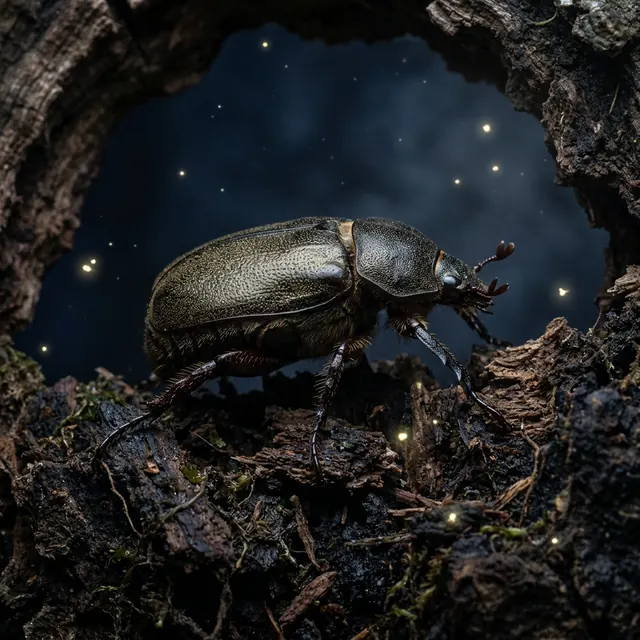
Hermit beetle
Osmoderma eremita
A large beetle, a relic of primeval forests. It spends its whole life in the wood mould of old, hollow trees. Despite its name (oak scent beetle in Polish) it is not tied to oaks; it also lives in lindens, alders and pollard willows. In northern Poland about 90% of its population now lives in roadside avenues, old parks and orchards. It is a priority species in the European Union.
How to recognise
- Length 22–32 mm, rarely up to 40 mm
- Brownish-black with a slight olive metallic sheen
- Broad wing cases, short antennae with a three-segmented club
- Larva white, bent into a C shape, up to 6 cm long
Where it lives
Old, hollow trees in sunlit spots: avenues, parks, orchards, field woodlots, cemeteries and open old forests. Most sites are in western and northern Poland and in the Białowieża Forest.
When you'll see it
The larvae develop in the hollow for 3–4 years. Adults are easiest to see on warm, sunny days on the trunk near the hollow's opening.
Tracks
A hollow with a spacious pocket of wood mould in an old, sunlit tree. On sunny days males sit on the trunk by the opening.
Tracks
Close-up of the inside of an old tree hollow filled with dark wood mould and a creamy white C-shaped beetle larva of the hermit beetle, realistic natural light. Realistic nature photograph, no people, no text, square composition.
When you meet it
Do not touch or take the beetle. Most important is not to cut down old, hollow trees in avenues and parks. An observation of a protected species is worth reporting to the Regional Directorate for Environmental Protection (RDOŚ).
Role in the forest
For 3–4 years the larvae feed in the wood mould of the hollow and help break it down. Protecting the hermit beetle means protecting old trees, which are used by many other species.
Fun fact
On sunny days males sit by the hollow's opening and give off a strong scent that attracts females. The Polish name ("pachnica", the fragrant one) comes from this smell. Dogs that detect the smell of the larvae are trained to search for sites of the beetle. In Poland such a programme was run in 2016 by the Żmigród Forest District (Nadleśnictwo Żmigród).