

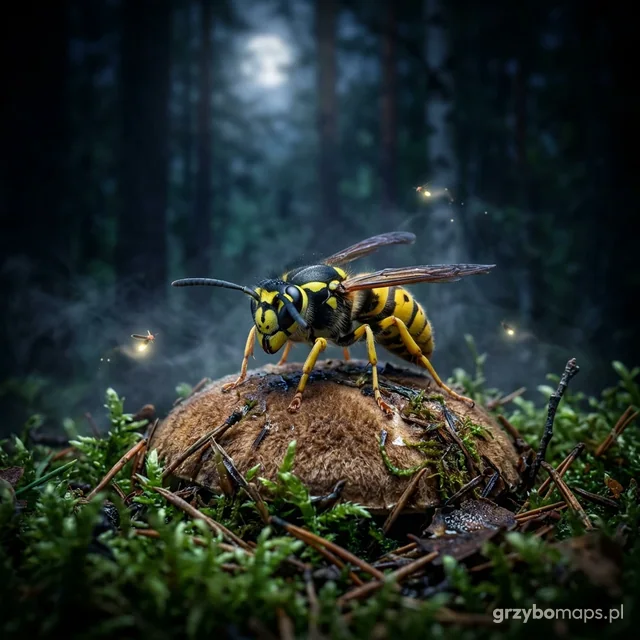
Common wasp
Vespula vulgaris
The most common social wasp in Poland. It often builds nests underground, in old burrows, so a forager can easily step on one. Towards the end of summer the workers look for sweet food and become pushy.
How to recognise
- Length 1.2 to 2 cm, slender, with a distinct waist
- Bright yellow-and-black pattern, with a black anchor-shaped mark on the face
- Fast, zigzag flight low over the ground near the nest entrance
- Comes to sweets, fruit and meat
Where it lives
Forests, glades, forest edges, gardens. Nests in the ground, in rotten wood, under roots, sometimes in attics.
When you'll see it
From April to October, most numerous in August and September.
Tracks
A hole in the ground or in a rotten stump into which wasps keep flying. Underground, a grey, papery ball of a nest.
Tracks
Close-up of a small hole in forest soil between moss and roots with several wasps entering and leaving, a ground nest entrance, realistic, late summer light.
When you meet it
Watch your step when picking mushrooms and avoid places where wasps fly into the ground. If wasps fly out, leave quickly, shielding your face; do not lie down and do not wave your arms. A wasp does not leave its stinger behind and can sting several times. Apply a cold compress to the sting. Shortness of breath, swelling of the throat, dizziness or a sting in the mouth call for 112. Do not drink from a sweet can in the forest without looking inside.
Role in the forest
A predator that catches caterpillars and flies for its larvae. Adult wasps feed on nectar, sap and fruit, so they also pollinate a little. It cleans up carrion.
Fun fact
Wasps make the paper for their nest themselves, chewing wood and mixing it with saliva. People watched this technique before wood-pulp paper was invented.