

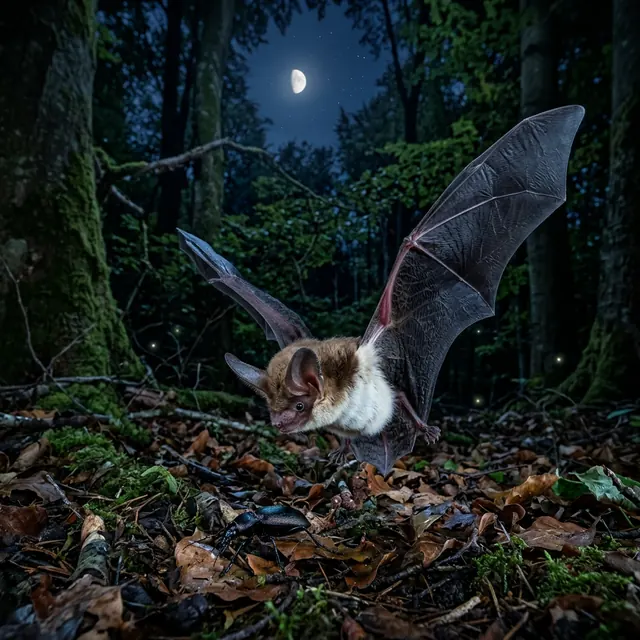
Greater mouse-eared bat
Myotis myotis
One of the largest bats in Poland, with a wingspan of 35–45 cm. In summer females form colonies in the attics of churches and large buildings; in winter they sleep in cellars and caves. It hunts ground beetles and other beetles, which it picks up from the forest floor.
How to recognise
- a large bat, weight 20–27 g
- back brown, belly distinctly white
- large, broad, oval ears
- in a colony they hang in tight clusters under the roof
Where it lives
Mainly southern and western Poland. It flies to old beech and oak forests with sparse undergrowth, freshly mown meadows and orchards to feed. It hibernates, among other places, in the Międzyrzecki Rejon Umocniony.
When you'll see it
Active from April to September. Winter sleep from September or October to April.
Tracks
Piles of droppings (guano) under beams in church attics. Chitinous beetle wing-cases at resting places.
When you meet it
Do not touch with bare hands. Bats can carry rabies viruses, and their bite can be so small that it is easy to overlook. Wash any bite or scratch with soap and water for ten-odd minutes and see a doctor. Move a weakened bat, wearing gloves, into a cardboard box with holes and call an animal rehabilitation centre or RDOŚ. Do not enter underground winter roosts from October to April, because every awakening costs the bat its fat reserve.
Fun fact
The greater mouse-eared bat does not need to see its prey by echolocation. It flies low over the leaf litter and listens to the rustle of beetles' footsteps, then lands and seizes them from the ground. It can live to 37 years.