

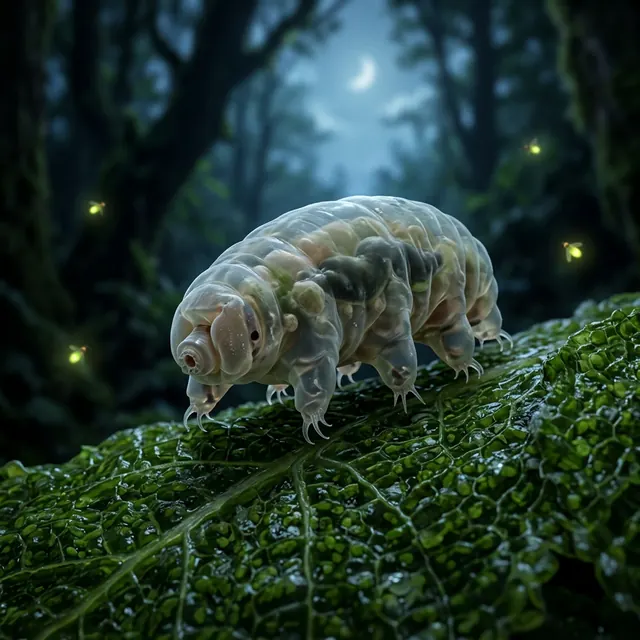
Tardigrade
Tardigrada
A microscopic animal. In English it is called the “water bear”, because it walks slowly and clumsily like a little bear. Its body is 0.05–1.2 mm long and it has four pairs of short little legs with claws. About 1500 species are known. It has no circulatory or respiratory system. The Latin name means “slow stepper”.
How to recognise
- Visible only under a microscope or a strong magnifying glass
- A plump, cylindrical body with 8 little legs ending in claws
- Transparent or the colour of the food it has eaten
- Moves slowly and clumsily
Where it lives
All over Poland. Easiest to find in moss and lichen on trees, walls and roofs, and also in leaf litter and in fresh water.
When you'll see it
All year round. When the moss dries out, the tardigrade goes into a dormant state and revives once it is soaked.
Tracks
No traces visible to the naked eye. A tuft of dry moss can be soaked in water and the water examined under a low-power microscope. This is how students and amateurs look at tardigrades.
Tracks
Close-up of a cushion of green moss growing on an old stone wall in Poland, with a few water droplets, the natural home of tardigrades, realistic macro. Realistic nature photograph, no people, no text, square composition.
When you meet it
Harmless to humans. A pinch of moss is enough for observation. After looking, put the moss back where you took it from.
Role in the forest
Part of the microscopic world of mosses, soil and waters. Most of them suck the contents of algae and plant cells, piercing them with tiny stylets in the mouth; some are predatory.
Fun fact
When it dries out, the tardigrade pulls in its legs and turns into a dry "barrel" in which life almost stops. In this state it survives for several years without water or food. In 2007, dried tardigrades spent 10 days outside a satellite in orbit. The vacuum of space alone did not harm them, but the full ultraviolet radiation of the Sun killed most of them. Scientists stress that tardigrades do not like extreme conditions; they are simply able to survive them for a while.