

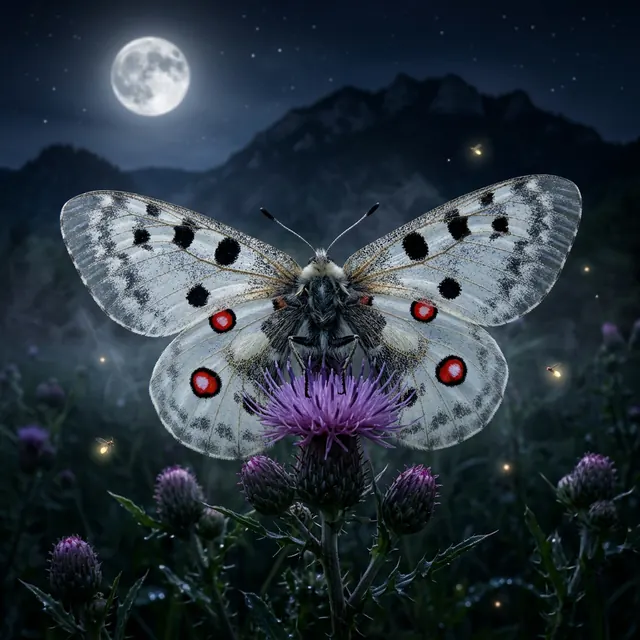
Apollo
Parnassius apollo
One of the largest day-flying butterflies in Poland. It once also lived in the lowlands, around Warsaw and Kielce. In the 20th century it nearly died out. It survived in the Pieniny, where a programme to save it ran in 1991–2010, and in the Tatras. Since 2005, about 500 adult butterflies have flown in the Pieniny.
How to recognise
- A large white butterfly
- Five black spots on the forewings
- Two red spots with a black border on the hindwings
- Caterpillar velvety navy-black with orange dots
Where it lives
Sunlit limestone slopes, scree and grasslands in the Pieniny and the Tatras, where stonecrop grows.
When you'll see it
The butterflies fly in July and August. Caterpillars feed in spring, even in full sun.
Tracks
Caterpillars on stonecrops: orpine in the Pieniny, white stonecrop and Carpathian stonecrop in the Tatras.
Tracks
Close-up of a velvety black Apollo butterfly caterpillar with rows of orange spots feeding on fleshy orpine (Sedum) leaves among limestone rocks, realistic macro. Realistic nature photograph, no people, no text, square composition.
When you meet it
Do not catch the butterfly and do not leave the trail onto the scree. The species is under strict protection. An observation of a protected species is worth reporting to the Regional Directorate for Environmental Protection (RDOŚ).
Role in the forest
An indicator of preserved, open limestone grasslands and scree, which without grazing become overgrown with forest.
Fun fact
After mating, the male leaves a jelly-like secretion on the female's abdomen, which hardens into a sheath and prevents her from mating with another male. The Polish name "niepylak" ("non-dusting") comes from the fact that the wings have almost no scales and leave no dust on the fingers. The Apollo disappeared from most sites when scree and wasteland were afforested and the stonecrop had nowhere to grow.