

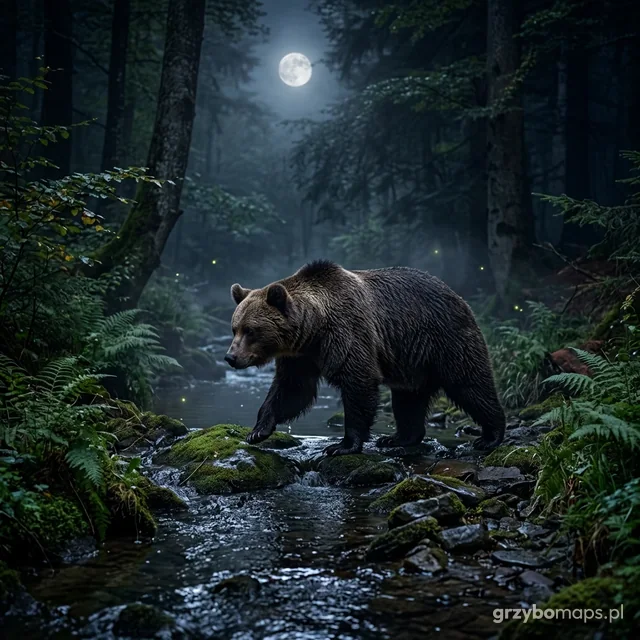
Brown bear
Ursus arctos
Poland's largest predator, although most of its diet is plants, fruit and insects. It sleeps through the winter in a den. In the Polish mountains it increasingly approaches people when it finds rubbish and food.
How to recognise
- massive body and a hump above the shoulder blades
- round ears and a broad head
- fur from light to dark brown
- hind paw print resembling a human bare foot
Where it lives
Bieszczady, Beskid Niski, Beskid Sądecki, the Tatras and other ranges of the Carpathians.
When you'll see it
From spring to autumn. Active mainly at dawn, dusk and at night.
Tracks
Tracks with five toes and long claws, hind paw up to about 25 cm. Torn-open anthills and ripped-apart stumps.
When you meet it
Do not run, a bear is much faster. Stay calm, do not look it in the eyes, speak calmly and slowly back away, preferably the way you came. Never approach the cubs, the mother is close. On the trail, make some noise from time to time so that it hears you. Do not leave food or rubbish.
What the beliefs say
The ancient Slavs probably avoided the true name of this dangerous animal and spoke of it in a roundabout way as the 'honey-eater'. That is how the word niedźwiedź came about.
Fun fact
The Polish name comes from a Proto-Slavic compound meaning 'honey-eater'.