

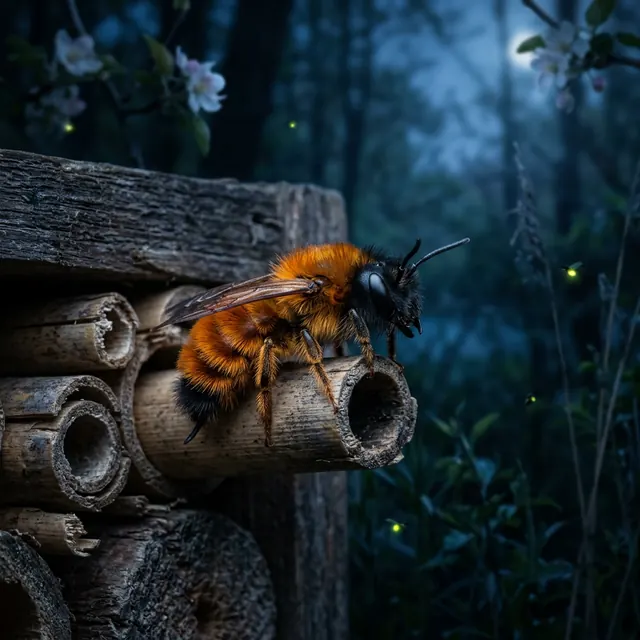
Red mason bee
Osmia bicornis
A solitary bee. It does not form a colony and does not make honey. The female builds the nest on her own in a ready-made passage, for example in a hollow stem or an old beetle tunnel in wood. She separates the cells for the larvae with walls of mud. It is the most commonly reared solitary bee, used for pollinating crops. In Poland it is common.
How to recognise
- Female 10–12 mm, male 8–10 mm, body with reddish hair
- The tip of the abdomen is covered with black hairs
- The female has black hairs on the head and two small bumps at the front of the head, the male pale yellow hairs and longer antennae
- It carries pollen on a reddish brush under the abdomen, not on the legs
Where it lives
Gardens, orchards, meadows, forest edges and towns. It nests in holes about 7–8 mm in diameter: in stems, crevices under bark, in wood and in insect houses.
When you'll see it
Adult bees from about April. The males emerge first, the females 1–2 weeks later. The larvae finish developing around September, then the adult bee overwinters in a cocoon.
Tracks
Reed tubes, holes in wood or in an insect house closed with a plug of mud. Inside a row of cells separated by mud walls, in each a ball of pollen and one egg.
Tracks
Close-up of the ends of hollow reed stems in a bee hotel, several tubes sealed with smooth grey-brown mud plugs made by red mason bees (Osmia bicornis), one tube cut lengthwise showing a row of cells separated by mud walls with yellow pollen balls, realistic macro. Realistic nature photograph, no people, no text, square composition.
When you meet it
Watch from close up without fear, but do not catch the bee in your hands. Only the female stings, and her sting has no barbs. Hang a bee house in a sunny place sheltered from rain. If you have signs of an allergy after a sting, that is shortness of breath, swelling of the face or dizziness, call 112.
Role in the forest
A spring pollinator of fruit trees and many wild plants. It gathers pollen from various plant species, but can be choosy.
Fun fact
The mason bee overwintering in its cocoon survives frost below −20 °C. The measured freezing point of its body is from −26 to −31 °C. Smaller and older females lay more eggs from which males hatch, because a male needs less food than a female. In this way they shorten the time the nest stands open to parasites.