

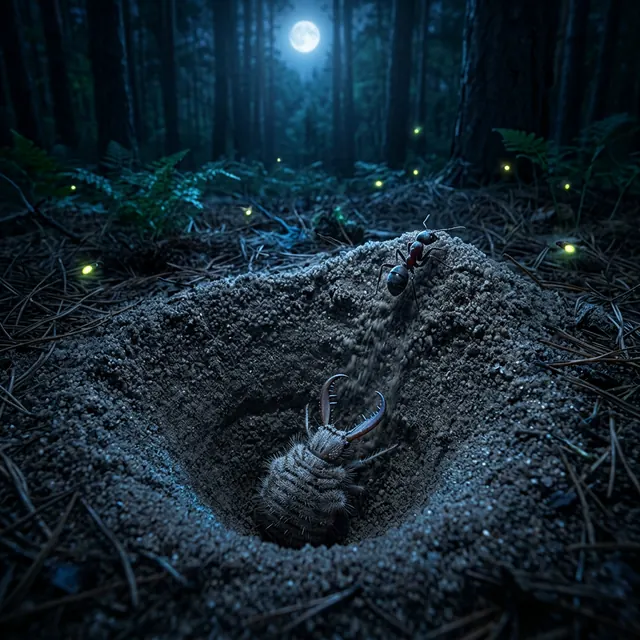
Common antlion
Myrmeleon formicarius
An insect of the order Neuroptera. The adult resembles a dragonfly, but flies slowly and has short, clubbed antennae. It is famous, however, for its larva, which digs a funnel-shaped trap in the sand and waits at the bottom for ants. It is widespread in Poland.
How to recognise
- Adult about 35 mm, slender, brownish-black
- Wings almost transparent, wingspan 66–83 mm
- Short antennae thickened at the tip
- Larva greyish-brown, stocky, about 12 mm, with huge mandibles
Where it lives
Warm, sandy places, especially pine forests. All over Poland.
When you'll see it
Larvae sit in the funnels in the warm season. Adults fly in summer, at dusk and at night.
Tracks
Small, funnel-shaped pits in dry sand, usually in groups. Only the larva's mandibles stick out of the bottom.
Tracks
Close-up of several perfect cone-shaped pits about 5 cm wide in dry fine sand under an overhanging pine root, antlion traps, realistic macro. Realistic nature photograph, no people, no text, square composition.
When you meet it
Harmless to humans. Do not dig up the funnels, just watch from close by.
Role in the forest
A predator. The larvae limit the number of ants and small insects on sandy ground; adults hunt insects at night.
Fun fact
When an ant tries to climb out of the funnel, the larva bombards it with grains of sand until the victim slides to the bottom. The larva's mandibles form a channel through which it injects venom and digestive enzymes into the prey, and then sucks out the liquefied contents. It tosses the empty remains out of the funnel.