

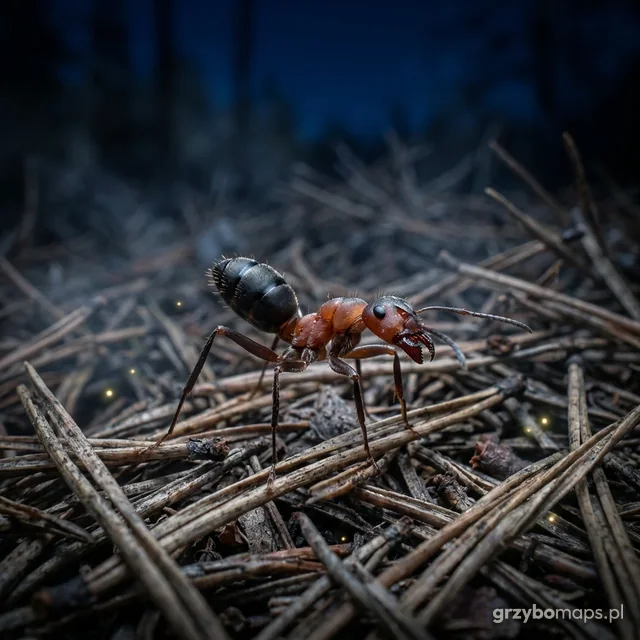
Red wood ant
Formica rufa
Builder of great mounds of conifer needles that in pine forests can be over a metre tall. Colonies number hundreds of thousands of workers. The red wood ant and its relatives, including the mrówka ćmawa, are partially protected in Poland, and their anthills are protected too.
How to recognise
- Workers 4 to 9 mm, front of the body reddish, abdomen black
- A mound of needles, twigs and bark flakes
- Ant trails leading to trees
- When disturbed they raise the abdomen and spray formic acid
Where it lives
Pine and spruce forests, mixed forests, most often at edges and in thinned stands.
When you'll see it
Active from March to October. In spring you can see ants basking on the mound.
Tracks
A mound of conifer needles, often next to a stump. Well-trodden ant roads, columns of workers walking up trees to aphids.
Tracks
Close-up of a large red wood ant mound built of pine needles and twigs at the base of a pine trunk, thousands of ants on the surface, morning light, Polish coniferous forest.
When you meet it
Do not sit on an anthill and do not rake it apart; this is forbidden and destroys the colony. A bite and formic acid sting; it is enough to rinse the skin with water. Acid in the eye must be rinsed out with clean water, and if the pain persists, go to a doctor.
Role in the forest
The forest police: a single colony eats huge numbers of caterpillars and other insects. It spreads plant seeds, turns over the soil, and farms aphids for honeydew. Dozens of other species live in anthills, and woodpeckers and other birds bathe in ants.
Fun fact
The anthill has a dome built to catch the sun. During the day the ants move larvae to warmer or cooler parts of the nest.