

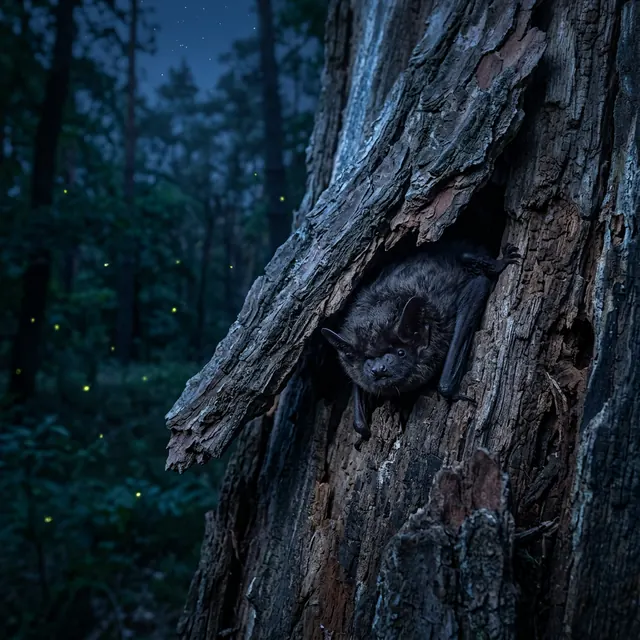
Western barbastelle
Barbastella barbastellus
A bat with a flat, pug-like face and broad ears joined above the forehead. In summer it hides behind loose bark on dead trees; in winter it hibernates in cool bunkers and forts. It specialises in catching moths.
How to recognise
- small, weight 5–14 g
- dark brown to almost black, long, silky fur
- short, broad ears joined at the bases above the forehead
- flat, short muzzle, like a pug
Where it lives
Old forests with dead and dying trees. Hibernates in fortifications, tunnels, old mines and cellars, including in Nietoperek.
When you'll see it
It sets out to hunt early in the evening, from April to October. Winter sleep from October or November to March, at a temperature of 0–5°C.
Tracks
Hard to find. Sometimes tiny droppings and moth wings under loose bark on dead trees.
When you meet it
Do not touch with bare hands. Bats can carry rabies viruses, and their bite can be so small that it is easy to overlook. Wash any bite or scratch with soap and water for ten-odd minutes and see a doctor. Move a weakened bat, wearing gloves, into a cardboard box with holes and call an animal rehabilitation centre or RDOŚ. Do not tear bark off dead trees, because barbastelles may be sleeping under it.
Fun fact
The barbastelle hunts quietly. Its echolocation calls are 10–100 times quieter than those of other bats that catch prey in flight, so moths that can hear ultrasound detect it only at close range. This is the first described case of such stealth echolocation.