

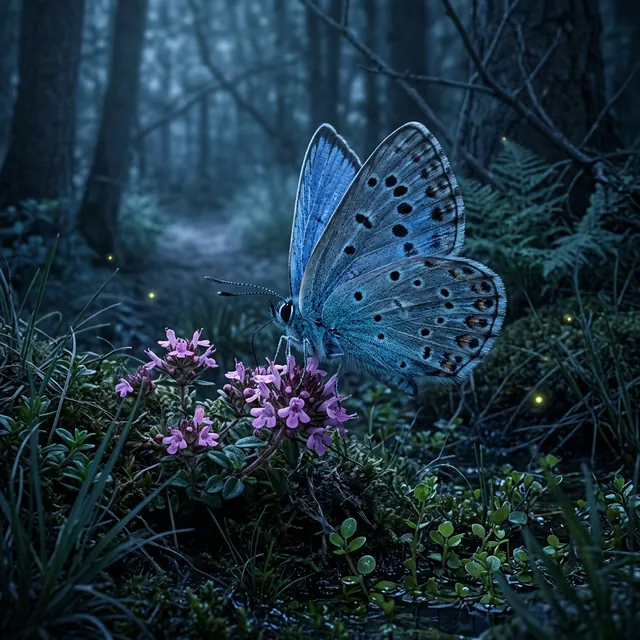
Large blue
Phengaris arion
A small blue butterfly with an unusual life. Its caterpillar spends most of its life in an ant nest, where it eats ant larvae. In Poland it was once common, today it lives at isolated sites. In Great Britain it died out in 1979 and was reintroduced thanks to new conservation methods.
How to recognise
- Wingspan 3–4 cm
- Pale blue wings with black spots on the forewings
- Female larger and darker than the male
- Settles on the pink and purple flowers of wild thyme and wild marjoram
Where it lives
Dry, sunlit grasslands and pastures with wild thyme or wild marjoram and with nests of Myrmica ants.
When you'll see it
The butterflies fly in July and August. From August to May the caterpillar lives in the ant nest.
Tracks
Clumps of wild thyme with tiny eggs in the flowers. The caterpillar itself is hidden in the ant nest.
Tracks
Close-up of red Myrmica ants carrying a pale pinkish caterpillar of the large blue butterfly into the entrance of their underground nest among wild thyme, realistic macro. Realistic nature photograph, no people, no text, square composition.
When you meet it
Do not catch the butterfly and do not dig up ant nests. To survive, it needs open, unovergrown grasslands. An observation of a protected species is worth reporting to the Regional Directorate for Environmental Protection (RDOŚ).
Role in the forest
An indicator of well-preserved warm grasslands. Its fate depends on both a plant and a single species of ant.
Fun fact
The young caterpillar first eats the flowers of wild thyme. Then it comes to resemble an ant larva in smell and body build. Myrmica ants carry it into their nest, and it lives there for about 10 months, eating the eggs and larvae of its hosts. In return the ants lick a secretion from its gland. In spring it pupates in the upper part of the ant nest.