

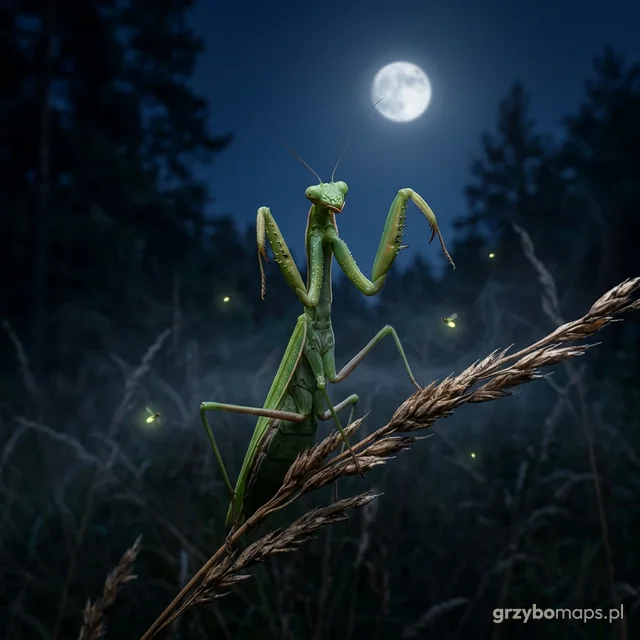
European mantis
Mantis religiosa
The only mantis in Central Europe. Formerly rare, today it is clearly expanding its range northward in Poland, which is linked to climate warming. It lies in wait motionless on plants and catches insects with its grasping front legs.
How to recognise
- Female 5 to 7.5 cm, male smaller
- Green or straw-brown
- Front legs folded as if in prayer
- A triangular, very mobile head
Where it lives
Dry, sunlit glades, grasslands, edges of pine forests, wasteland.
When you'll see it
Adults from August to October. Eggs overwinter in a cocoon (ootheca).
Tracks
Ootheca: a pale, foamy capsule with eggs attached to a stem or a stone.
Tracks
Close-up of a pale beige foamy mantis ootheca attached to a dry plant stem in autumn grass, realistic.
When you meet it
Harmless. A strictly protected species; do not catch or take it, and a sighting is worth reporting to scientists.
Role in the forest
A predator that eats flies, grasshoppers, butterflies and spiders. Food for birds.
Fun fact
The female does not always eat the male after mating. According to research this happens in a minority of cases, less often in the wild than in captivity.