

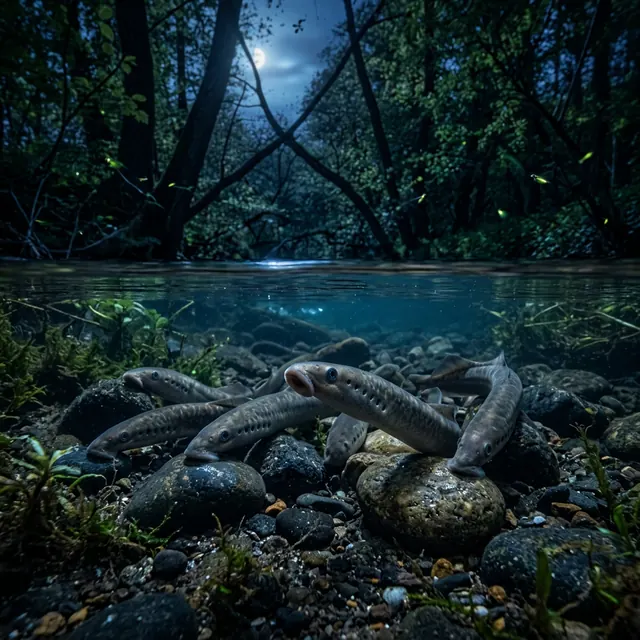
Brook lamprey
Lampetra planeri
It is not a fish, but a primitive jawless vertebrate, a relative of the oldest vertebrates. Instead of a mouth it has a round sucker with horny teeth, and instead of a backbone a notochord. The larvae live in the mud for 4–5 years, while adult lampreys do not eat at all and die right after spawning.
How to recognise
- up to 16 cm, very thin, about 8 mm thick
- body like a small eel, without scales, slippery
- funnel-shaped sucker instead of jaws
- behind the eye a row of 7 small gill openings on each side
- no paired fins, two dorsal fins touching each other
Where it lives
Upper stretches of clean, cold and well-oxygenated rivers and streams, most often tributaries of the Vistula. Sandy-gravelly bottom.
When you'll see it
Spawning in spring, when adult lampreys gather in small groups on the gravel. For the rest of the year the larvae stay hidden in the mud.
Tracks
In spring, in a shallow, clean stream, small groups of lampreys attached to stones on the gravel bottom, near muddy spots where the larvae live.
When you meet it
Do not catch it and do not use the larvae as bait, because the lamprey is protected. Watch from the bank. Its presence is a sign of very clean water.
Fun fact
The lamprey has a single nostril in the middle of its head and keeps its notochord throughout life. After metamorphosis into the adult form, its digestive tract degenerates and its body becomes shorter than that of the larva.