

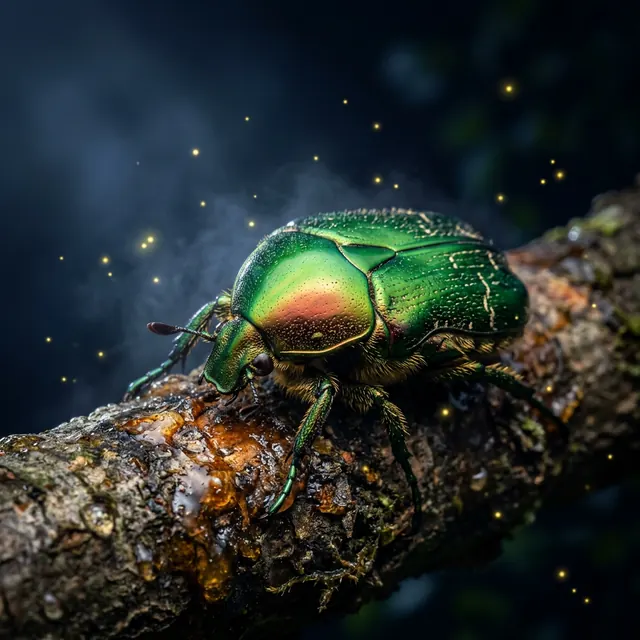
Kwietnica okazała (Protaetia aeruginosa)
Protaetia speciosissima
A large, grass-green beetle, shining like metal. In many areas of the country it has died out and is rarely seen today. Its larvae develop in the rotting wood of high-up hollows of old trees, mainly oaks.
How to recognise
- Length 19–34 mm
- Grass-green, metallic and shiny, sometimes with a red or blue sheen
- Underside of the body densely covered with golden hairs
- Flies fast and high in the tree crowns
Where it lives
Open, sunlit old deciduous stands, oak-hornbeam forests, floodplain forests, old avenues and parks with hollow oaks.
When you'll see it
From the end of April to mid-September, most at the turn of June and July.
Tracks
Hollows and thick, high-up branches with rotting wood. The beetle often uses tunnels gnawed by the great capricorn beetle.
Tracks
Close-up of a high hollow in a thick old oak branch with crumbly reddish wood mould and a large exit hole, realistic natural light. Realistic nature photograph, no people, no text, square composition.
When you meet it
Admire, do not catch. Leave old, hollow oaks at forest edges, in parks and by roads. An observation of a protected species is worth reporting to the Regional Directorate for Environmental Protection (RDOŚ).
Role in the forest
The larvae break down rotting wood in the crowns of old trees. Adults visit flowering shrubs and drink sap from trees and ripe fruit.
Fun fact
The beetle flies with its wing cases closed. The side edges of the wing cases are deeply notched, so the wings slip out from under them sideways. Its white larvae, up to 7 cm long, can crawl on their backs.