

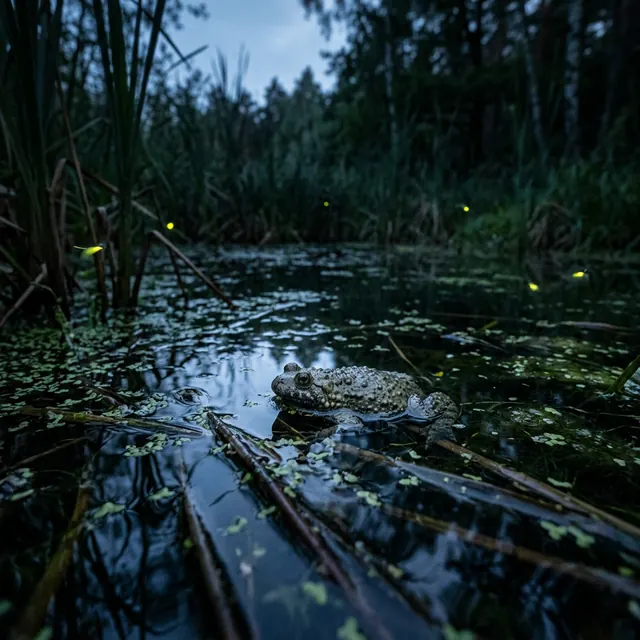
European fire-bellied toad
Bombina bombina
A small, flat froglet, more like a miniature toad than a frog. Grey-brown and unremarkable on top, underneath it has a bright red-orange belly with black and grey blotches. The skin secretes a foaming mucus with a toxin that is poisonous to animals and to humans.
How to recognise
- up to 6 cm long, body very flattened
- back olive or grey, with warts
- belly with red or orange patches on a dark background, with tiny white dots
- eyes small, set towards the back of the head
- in spring you can hear a soft, mournful oom, oom from the water
Where it lives
The whole Polish lowland, up to about 400 m above sea level. Shallow, sunny ponds, oxbow lakes, floodplains, even puddles and water-filled ruts at the forest edge.
When you'll see it
From April to September, active day and night. Mating from April, when the water warms to about 10°C. Hibernates on land, in burrows about 50 cm underground.
Tracks
Mating call: a soft, repeated oom, oom coming from shallow water. Spawn in small clumps of 2–80 eggs, stuck to aquatic plants.
When you meet it
Do not catch or move it. If you touch a fire-bellied toad, wash your hands and do not rub your eyes, because the mucus burns and irritates the mucous membranes. Keep your dog away, because the toxin can harm it. Do not put fish into small waters where fire-bellied toads live.
Fun fact
A frightened fire-bellied toad arches its body or flips onto its back and freezes, showing its red belly. This is the so-called unken reflex: a warning to a predator that the prey is poisonous.