

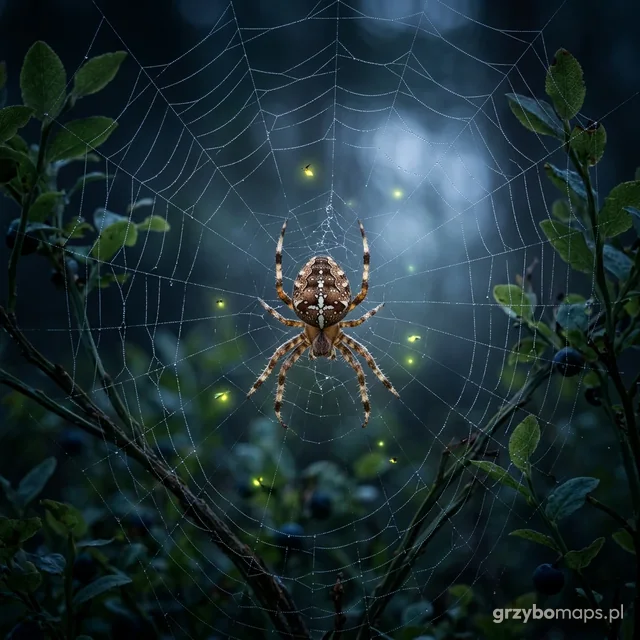
European garden spider
Araneus diadematus
A spider that weaves classic circular webs which glisten with dew on an autumn morning. On its abdomen it has a white cross-shaped pattern. It is venomous to insects but harmless to humans.
How to recognise
- Female 10 to 18 mm, male 6 to 7 mm
- A white cross of spots on a brown abdomen
- A round web with radial threads, up to about 45 cm in diameter
- Sits in the middle of the web or in a retreat beside it
Where it lives
Forests, glades, thickets, gardens, parks, even buildings.
When you'll see it
Most large females from August to October.
Tracks
Circular webs between twigs, best seen at dawn with dew drops. In autumn, yellowish egg cocoons in crevices.
Tracks
Close-up of a perfect orb web covered with dew drops strung between spruce twigs in morning mist, backlit by low sun, magical glowing beads, realistic.
When you meet it
A bite is rare and resembles a mosquito bite. There is no need to do anything beyond washing the skin.
Role in the forest
Catches huge numbers of flies, mosquitoes and other insects. Food for birds and wasps.
What the beliefs say
In Polish folk beliefs the spider brought luck and prosperity. It was believed that it must not be killed, because that would bring misfortune or rain.
Fun fact
The garden spider often eats its old web, recovering the protein, and weaves a new one. After mating the male runs away so as not to be eaten.