

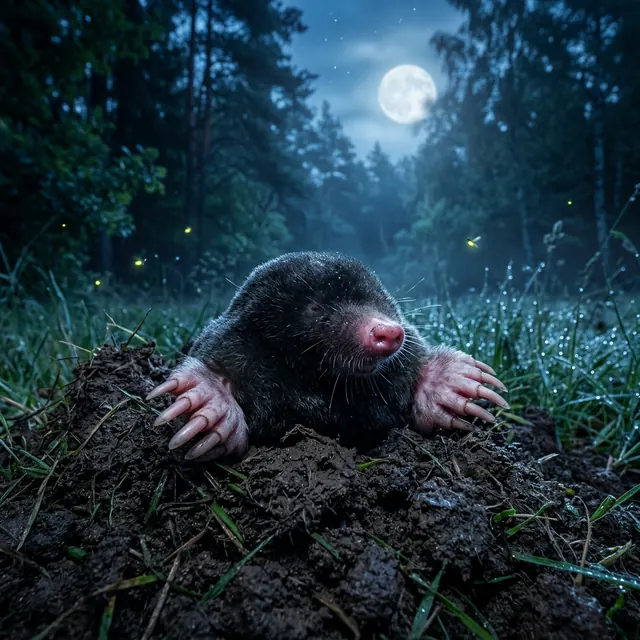
European mole
Talpa europaea
An underground mammal with black, velvety fur and spade-like front paws. Its eyes are tiny, about 1 mm, and it senses prey by vibrations and hearing. It digs tunnels at 12–15 m per hour and does not hibernate.
How to recognise
- body up to 17–20 cm, weight up to about 120 g
- dense, black fur, velvety to the touch
- huge, spade-like front paws with claws
- pink snout, eyes almost invisible, no external ears
Where it lives
All of Poland. Meadows, pastures, deciduous forests, gardens – wherever the soil is moist and fertile, full of earthworms.
When you'll see it
All year round. It piles up the most mounds in the morning hours.
Tracks
Molehills, i.e. mounds of pushed-up soil with no visible hole, often in a line. On boggy soils the mounds are even 90 cm high.
When you meet it
Outside gardens, moles must not be killed or caught. Molehills on a meadow are a sign of healthy, fertile soil full of earthworms. If a mole bothers you in the garden, it is better to scare it off than to poison it, because poisons also harm other animals.
Fun fact
The mole makes larders from live earthworms. It bites them so they cannot escape and keeps even several hundred in a chamber for the winter.