

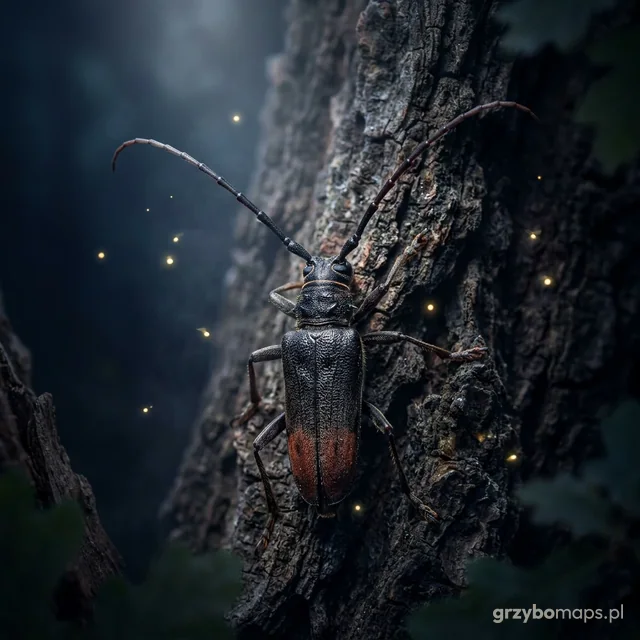
Great capricorn beetle
Cerambyx cerdo
One of the largest Polish longhorn beetles, with antennae longer than its body. It lives only on old, sunlit oaks, which it bores through for years with wide tunnels. It is strictly protected and also safeguarded by Natura 2000 areas.
How to recognise
- Length 2.4 to 5.3 cm, blackish-brown
- Very long antennae, clearly longer than the body in the male
- Wing covers lighter, reddish-brown towards the rear
- Flies at dusk around old oaks
Where it lives
Old oaks, standing singly or loosely, especially in the valleys of large rivers, parks and avenues. Most numerous in western Poland.
When you'll see it
Adults from May to August, active in the evening and at night.
Tracks
On the trunks of living oaks, large oval exit holes as wide as a thumb and wood dust spilling out. Under the bark, wavy, wide larval tunnels.
Tracks
Close-up of the trunk of a living old oak with several large oval exit holes and fine pale wood dust, deeply furrowed bark, realistic.
When you meet it
Do not touch or move it. If you know of an old oak with great capricorn beetle holes that is due to be felled, report it to the Regional Directorate for Environmental Protection (RDOŚ) or the forest district office.
Role in the forest
An ecosystem engineer: the larval tunnels open up the wood for fungi, other beetles, birds and bats. An indicator of valuable old oak woods.
Fun fact
The larva develops in the wood for 3 to 5 years and grows up to 9 cm. It chooses oaks a hundred years old or older, standing in the sun.