

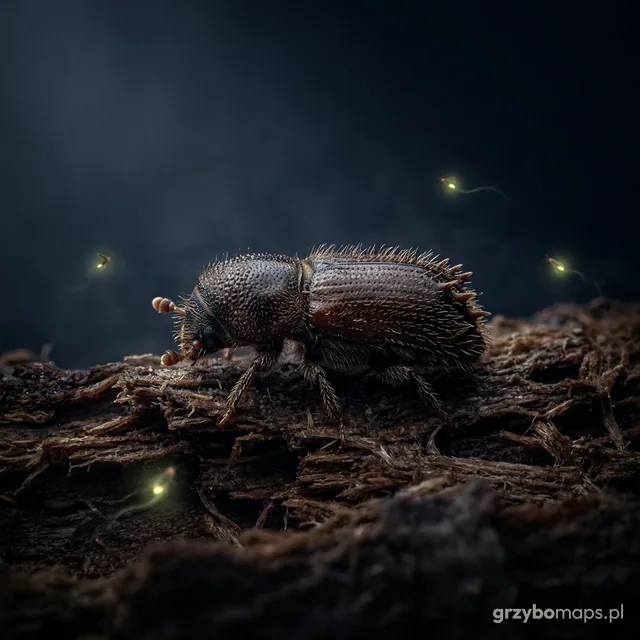
European spruce bark beetle
Ips typographus
A tiny beetle with a huge impact on spruce forests. It lives under spruce bark, and when trees are weakened after drought or windthrow its numbers rise sharply and many hectares of stand then die. It owes its name to the patterns of its galleries, which resemble print.
How to recognise
- Length 4 to 5.5 mm, dark brown, cylindrical
- Rear of the wing covers truncated, with teeth along the sides
- Almost always under spruce bark
- Hairy; you mostly see it by its traces
Where it lives
Spruce forests and stands throughout Poland, most numerous in the mountains and the north-east, including in Puszcza Białowieska.
When you'll see it
Swarming from April to May; in warm weather further generations in summer.
Tracks
Under the bark, maternal galleries running along the trunk, usually 2 or 3, with larval galleries running at right angles from them. On the bark, rusty boring dust in the cracks, resin flows, later a browning crown and falling bark.
Tracks
Close-up of the inner side of peeled spruce bark showing bark beetle galleries: two or three straight vertical maternal galleries from a central chamber with many fine larval galleries branching sideways like printed text, warm brown wood tones.
When you meet it
Harmless to humans. You can look at the gallery pattern on fallen bark. Do not carry bark and spruce wood out of the forest.
Role in the forest
In a natural forest it speeds up the turnover of tree generations and creates dead wood used by woodpeckers, other beetles and fungi. It carries the spores of blue-stain fungi, which colour the wood blue. In spruce monocultures it is a dangerous pest.
Fun fact
A bark beetle outbreak usually lasts several years and collapses on its own. In Puszcza Białowieska the dispute over whether to fight it by felling went to the Court of Justice of the EU in 2017.