

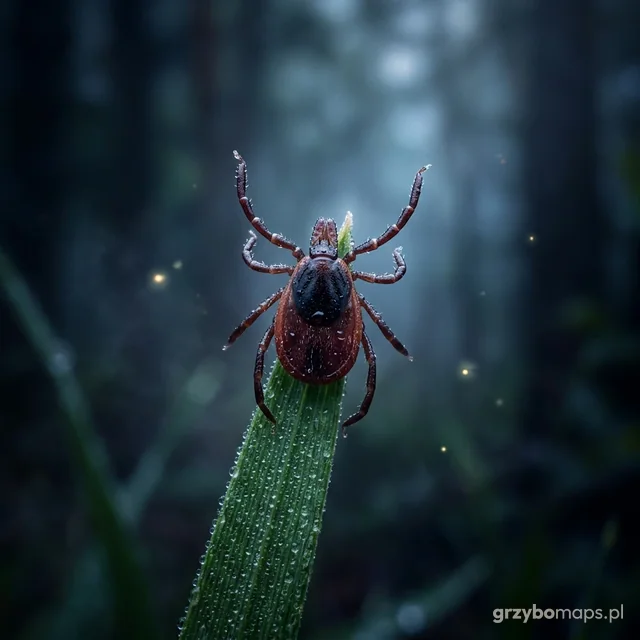
Castor bean tick
Ixodes ricinus
The most important resident of the undergrowth for a forager, though it is only a few millimetres long. It is an arachnid that waits on grasses and shrubs, then bites into the skin and drinks blood for several days. It transmits, among other things, Lyme disease and tick-borne encephalitis (TBE).
How to recognise
- Adults have four pairs of legs, larvae have three pairs
- Female reddish-brown with a black scutum; after feeding grey and the size of a pea
- Nymphs are about 1 mm long and easy to overlook
- An attached tick looks like a dark dot or a small mole
Where it lives
All of Poland. Deciduous and mixed forests, their edges, thickets, tall grass, ferns, and also city parks.
When you'll see it
Active from early spring to late autumn whenever the temperature is above a few degrees. Peaks are usually in May and June and in September and October.
Tracks
Leaves no visible traces in the forest. On the body: an attached arachnid, then slight redness. Erythema migrans is a red patch, often clearing in the middle, that grows over the following days.
Tracks
Close-up of human skin on a forearm showing erythema migrans: an expanding round red patch with paler centre around a tiny bite point, realistic medical-educational style, neutral soft light.
When you meet it
After every trip to the forest, check your whole body, including the groin, armpits, behind the ears, and the scalp of children. Remove the tick as quickly as possible: grasp it with tweezers or a tick-removal tool right at the skin and pull it out with a firm, steady motion. Do not smear it with grease, butter, alcohol or anything else, and do not burn it, because the tick may then regurgitate more of its contents into the wound. Then disinfect the skin and the tool, and wash your hands. Watch the bite site for about a month. See a doctor if an expanding red patch appears (usually 3 to 30 days after the bite), or fever, headaches, muscle and joint pain, or neurological symptoms. Vaccination protects against TBE; it is the only tick-borne disease you can be vaccinated against.
Role in the forest
A parasite of mammals, birds and reptiles, and food for some birds. In nature it is a link in the circulation of bacteria and viruses among wild animals, mainly rodents, birds and roe deer.
Fun fact
A tick does not jump and does not fall from trees. It climbs up blades of grass and stretches out its front legs, which carry Haller's organ that senses the carbon dioxide and warmth of a passing animal. The TBE virus can also be transmitted through unpasteurised milk from infected goats, sheep or cows.