

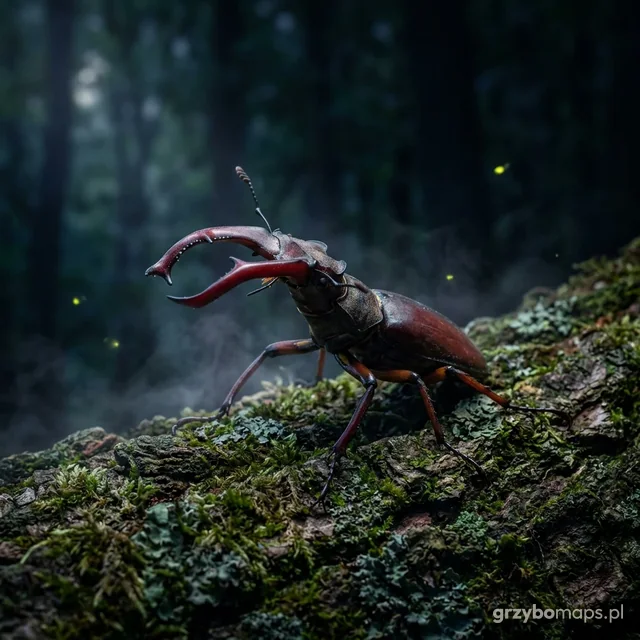
Stag beetle
Lucanus cervus
The largest beetle in Europe. Males have huge mandibles resembling deer antlers and use them in fights over females. The larvae develop for several years in decaying oak wood.
How to recognise
- Male 3.5 to 7.5 cm with reddish-brown, branched mandibles
- Female smaller, with short, sharp mandibles
- Black head and pronotum, brown wing covers
- Flies heavily and noisily at dusk
Where it lives
Old oak woods, deciduous forests, parks and avenues with old oaks. Rare, with scattered sites.
When you'll see it
Adults from late May to July, most active on warm evenings in June.
Tracks
Rotting oak stumps and roots with oval exit holes. Males gather at sap flows on oak trunks.
Tracks
Close-up of a decaying oak stump with soft reddish rotten wood and oval exit holes of stag beetle larvae, moss and leaf litter around, realistic forest light.
When you meet it
Admire it up close, but do not take it home or move it; the species is protected. The female can pinch painfully. Leave old oak stumps in peace.
Role in the forest
The larvae break down dead oak wood, turning it into humus. Adults are food for owls, corvids and bats. An indicator species of old forests.
Fun fact
The larva lives in the wood for 3 and even 5 or more years, while the adult beetle lives only a few weeks and hardly eats, at most licking sap from trees.