

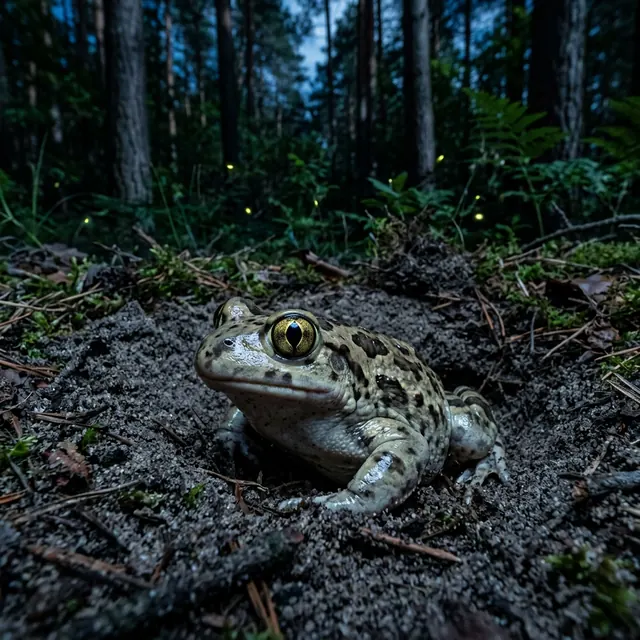
Common spadefoot
Pelobates fuscus
A stocky amphibian with bulging eyes and a vertical pupil, like a cat's. It spends the day buried in sandy soil, which it pushes aside with hard calluses on its hind feet. When irritated, it releases a garlic-smelling substance from its skin glands.
How to recognise
- 5–8 cm long, smooth skin
- large, bulging eyes with a vertical pupil
- back light ash-grey or olive with dark blotches
- a hard, horny callus for digging on the underside of the hind feet
- when startled it does not flee but buries itself in the soil
Where it lives
Lowlands across the whole country. Sandy soils, fields, vegetable gardens, heaths and the edges of pine forests. For mating it chooses ponds, ditches and flooded meadows.
When you'll see it
Mating in March and April, sometimes again in summer. Outside the mating season it is active at night, from spring to autumn. Hibernates buried deep in the soil.
Tracks
Spawn in the form of a thick cord 40–100 cm long and about 2 cm wide, wound around plants in the water. The tadpoles are huge, up to a dozen or so cm, longer than the adult frog.
When you meet it
Do not dig it up or move it. If you find a spadefoot while digging in the garden, gently place it back in moist, soft soil nearby. After touching it, wash your hands. A garden without chemicals and with loose soil is the best place for it.
Fun fact
When pulled by the skin, the spadefoot smells of garlic, stands on its hind legs, puffs itself up and screams loudly. One of its old scientific names was Rana alliacea, the garlic frog.