

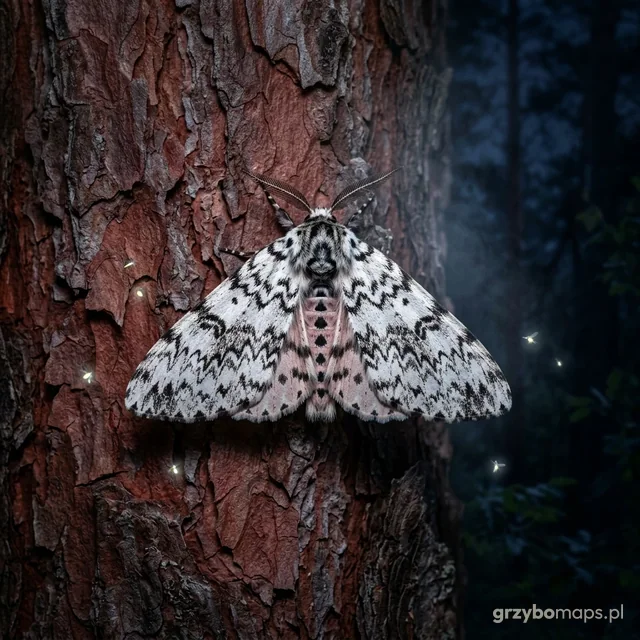
Black arches
Lymantria monacha
An inconspicuous black-and-white moth whose caterpillars can strip whole pine forests of needles. In Polish pine and spruce forests mass outbreaks occur from time to time. Foresters count eggs and moths to predict an outbreak.
How to recognise
- Wingspan 3.5 to 5.5 cm
- White wings with black zigzags
- Abdomen with a pink tinge
- Caterpillar grey-brown, heavily hairy, with warts
Where it lives
Pine and spruce forests, also mixed forests.
When you'll see it
Moths in July and August, caterpillars from May to July. Eggs overwinter in bark crevices.
Tracks
Gnawed needles, caterpillar droppings on the litter, groups of eggs in bark cracks, moths sitting on trunks.
Tracks
Close-up of a pine twig with partly chewed needles and a hairy grey-brown caterpillar, frass on the needles, realistic.
When you meet it
Harmless. It is better to handle hairy caterpillars only through a leaf, to avoid skin irritation.
Role in the forest
Food for birds and parasitic insects. In natural forests its numbers are controlled by viruses, birds and parasites; in pine monocultures it can be a dangerous pest.
Fun fact
The caterpillars of the black arches waste a lot of food: they bite through a needle and eat only part of it, so the damage is greater than what they eat.