

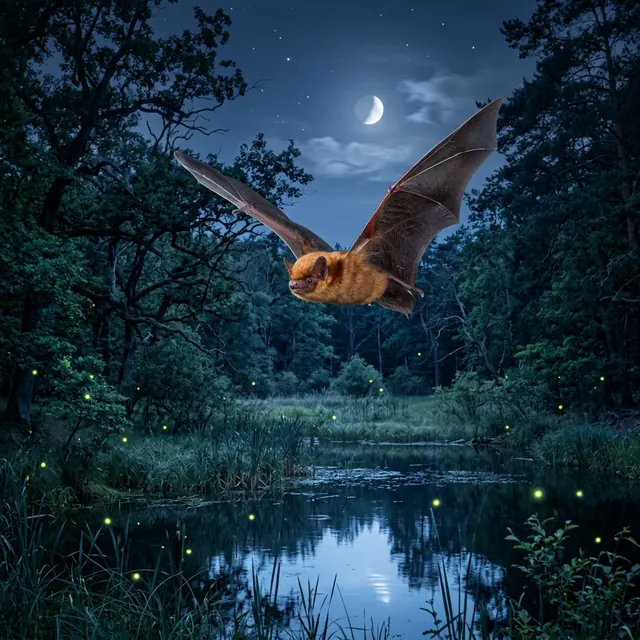
Common noctule
Nyctalus noctula
A large, reddish forest bat with narrow wings and a fast flier. It sets out to hunt early, often while it is still light, and hunts high above the treetops and water. It spends the day in high tree hollows, and increasingly in buildings too.
How to recognise
- weight 17–44 g, long, narrow wings
- glossy, uniformly reddish fur
- short, rounded ears
- fast flight high against the evening sky, with sharp turns
Where it lives
All of Poland. Old deciduous forests and parks with hollow trees, the surroundings of rivers and lakes, also cities.
When you'll see it
From March to November, in the evening, even before sunset. Some individuals make long migrations to their winter roosts.
Tracks
Brown streaks and droppings below the entrance of a tree hollow. From the hole you can hear sharp squeaks and chirping, especially in late summer.
When you meet it
Do not touch with bare hands. Bats can carry rabies viruses, and their bite can be so small that it is easy to overlook. Wash any bite or scratch with soap and water for ten-odd minutes and see a doctor. Move a weakened bat, wearing gloves, into a cardboard box with holes and call an animal rehabilitation centre or RDOŚ. Do not cut down old hollow trees in parks and gardens, because colonies may live in them.
Fun fact
The noctule uses ultrasound of a relatively low frequency, 18–22 kHz. In the mating season males call to females from tree hollows with sounds that humans can hear. The longest recorded flight of this bat is 1600 km.