

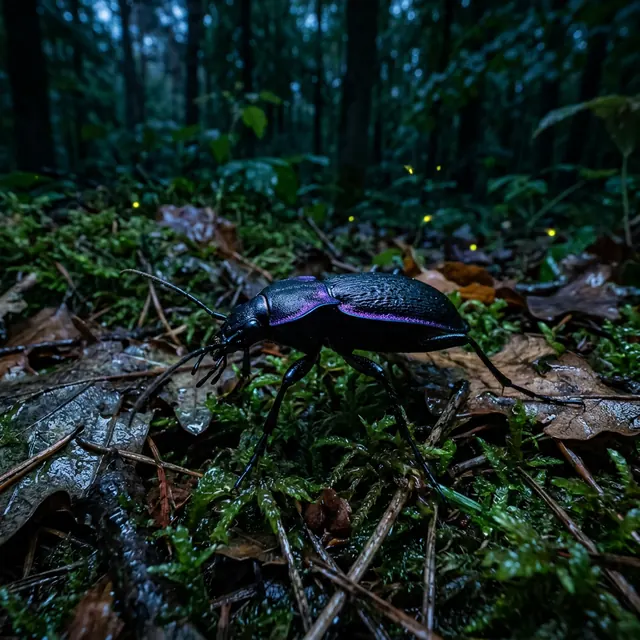
Violet ground beetle
Carabus violaceus
A large, nocturnal predator of the forest floor. It does not fly, it just runs fast. By day it hides in moss, under stones and pieces of wood. The edges of its body shimmer with violet and blue metal.
How to recognise
- Length 18–35 mm
- Black, with the edges of the pronotum and wing cases metallic violet or blue
- Wing cases smooth or with delicate rows of bumps
- Long legs, runs fast
Where it lives
Damp deciduous and mixed forests with humus-rich soil, floodplain meadows. It avoids dry places.
When you'll see it
From June to August, active at night.
Tracks
No distinct traces. It is often seen on forest paths after rain.
Tracks
Close-up of a damp forest path with fallen leaves and a slug, a violet ground beetle approaching, realistic macro after rain. Realistic nature photograph, no people, no text, square composition.
When you meet it
Harmless. Do not collect it. Watch out for it on paths.
Role in the forest
A predator of insects, their larvae, snails and earthworms. It also eats carrion and fungi. It is itself sometimes food for jackdaws and blackbirds.
Fun fact
Because it does not fly, a few kilometres of meadows or fields can be an insurmountable barrier for it. Studies have shown that it does not colonise forests lying on the other side of such a gap. That is why it is sensitive to forests being broken up into small pieces. In English it is sometimes called the "rain beetle".