

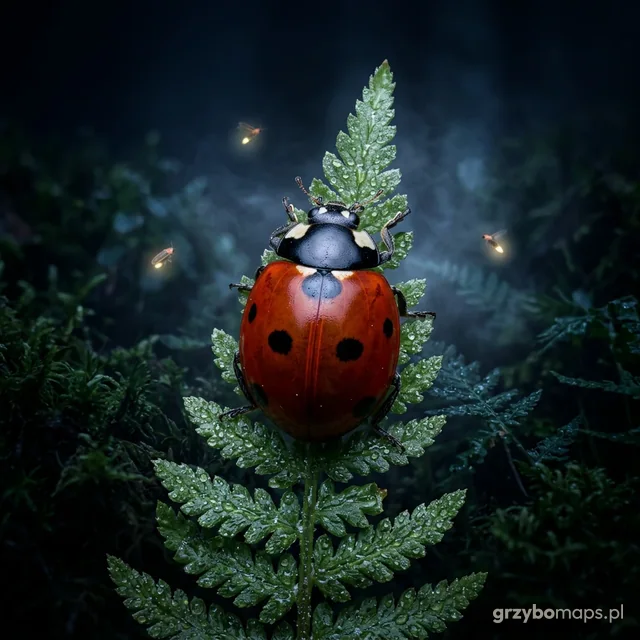
Seven-spot ladybird
Coccinella septempunctata
Poland's best-known ladybird, red with seven black spots. Both larvae and adults eat masses of aphids. It competes with the invasive Asian ladybird, which is displacing it in many places.
How to recognise
- Length 5 to 8 mm
- Red wing cases with seven black spots
- Black pronotum with white spots at the sides
- Larvae grey-blue with yellow spots
Where it lives
Forest edges, glades, meadows, gardens, wherever there are aphids.
When you'll see it
From March to October. The adult overwinters in groups, in leaf litter and under bark.
Tracks
Yellow, elongated eggs in clusters under leaves, pupae attached to leaves.
Tracks
Close-up of a cluster of yellow elongated ladybird eggs on the underside of a green leaf next to a colony of aphids, realistic.
When you meet it
Harmless. When alarmed, it secretes a yellow, bitter fluid that can leave a stain on the skin.
Role in the forest
A natural enemy of aphids, one of the important allies of gardeners and foresters.
What the beliefs say
The folk name boża krówka (“God's little cow”) has been known in Polish for at least 300 years, alongside the name krówka Matki Bożej (“Our Lady's little cow”).
Fun fact
The yellow fluid is hemolymph secreted from the leg joints. It contains bitter alkaloids, and the bright colour warns predators that the ladybird is distasteful.