

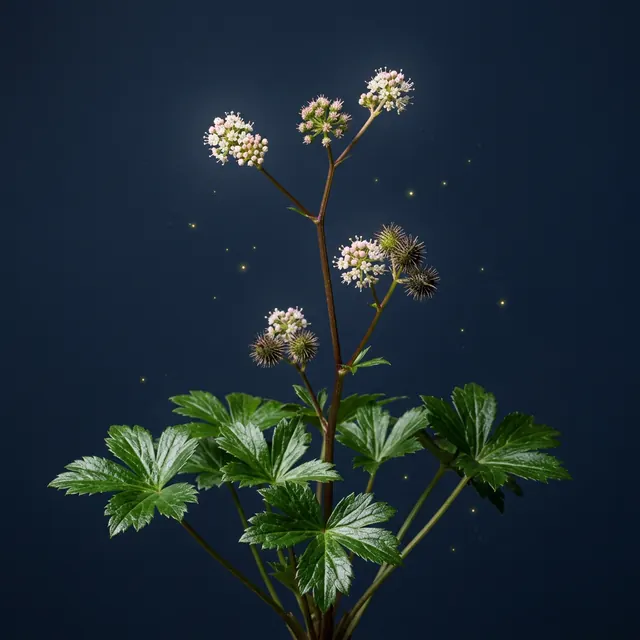
Sanicle
Sanicula europaea L.
Polish folk names: żankiel, sanikuła, Herba Saniculae
Traditional use
In folk medicine the herb and leaves were used for bleeding and to speed up wound healing. In Austria it is still known today as a folk remedy for wounds. It contains triterpene saponins, tannins and hydroxycinnamic acid derivatives; an analysis from 2025 confirmed this composition, but its efficacy in humans has not been studied. There is no EMA monograph.
What it looks like
Hairless perennial of shady deciduous forests, 20–60 cm (rarely up to 120 cm). Basal leaves on long stalks, glossy, dark green, palmately divided into 3–5 wedge-shaped, toothed segments. Stem almost leafless. Small white or pinkish flowers in little round, head-like umbels. Fruits round, 4–5 mm, covered in hooked bristles that cling to clothing.
Harvest
Gathered: herb (aerial parts), leaf, rhizome.
When: May – July.
Form: infusion, compress.
Lookalikes
- buttercups (e.g. creeping buttercup) – similar palmate leaves in shady woods, but yellow flowers; poisonous
- nine-leaved toothwort (Cardamine enneaphyllos) – in Austria confused in the trade with the root of sanicle
- greater masterwort – also has head-like umbels, but with large, coloured bracts
The information is educational and describes traditional use according to EMA/HMPC monographs (the European Medicines Agency and its Committee on Herbal Medicinal Products).It does not replace the advice of a doctor or pharmacist. Never eat a plant you are not 100% sure you recognise.