

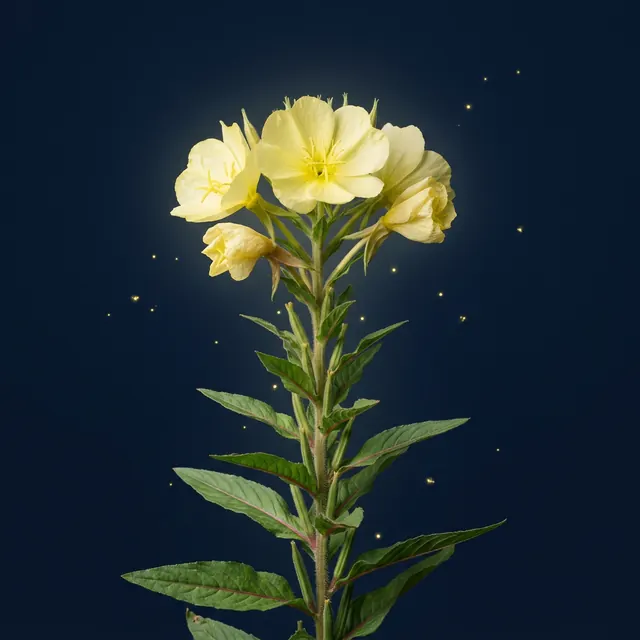
Common evening primrose
Oenothera biennis L.
Polish folk names: nocna świeca, wiesiołek
Traditional use
Traditionally (EMA/HMPC), evening primrose seed oil taken by mouth relieves itching in short- and long-term dry skin. The EMA also assessed studies in atopic dermatitis: a slight improvement is possible, but the evidence is of low or moderate quality. The oil is rich in gamma-linolenic acid. Young leaves, shoots and roots are edible once cooked.
What it looks like
Biennial: in the first year a rosette of leaves at ground level, in the second an upright, hairy stem 50–150 cm tall. Leaves oblong-lanceolate, often with a red midrib. Flowers large, pale yellow, with 4 broad petals 2–3 cm long; they open in the evening, are fragrant and are pollinated by moths. Fruits are narrow, oblong capsules.
Harvest
Gathered: seed oil, young leaves and root (kitchen).
When: August – October.
Form: oil (capsules, by mouth), kitchen.
Lookalikes
- Other evening primroses (several species and hybrids in Poland) – very hard to tell apart; harmless
- Mullein – also has yellow flowers on a tall stem, but the flowers are 5-petalled and the leaves thick and woolly
The information is educational and describes traditional use according to EMA/HMPC monographs (the European Medicines Agency and its Committee on Herbal Medicinal Products).It does not replace the advice of a doctor or pharmacist. Never eat a plant you are not 100% sure you recognise.