

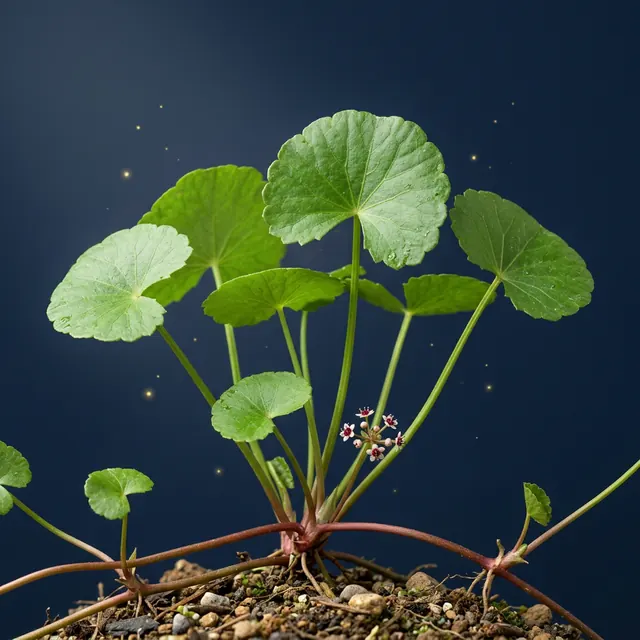
Asian pennywort – gotu kola
Centella asiatica (L.) Urb.
Polish folk names: gotu kola, centella, wąkrota azjatycka
Traditional use
Traditionally (EMA/HMPC) as an aid to the healing of minor wounds – for use on the skin. In the cuisines of Asia (e.g. Sri Lanka) the leaves are eaten as a vegetable. An oral effect on memory or circulation is not confirmed.
What it looks like
Low, creeping perennial rooting at the nodes. Leaves on long stalks, round or kidney-shaped, crenate, 1–6 cm across, with radiating veins. Small white or reddish flowers in little heads close to the ground.
Harvest
Gathered: herb (aerial parts).
Form: ointment, cream, infusion.
Lookalikes
- Marsh pennywort (Hydrocotyle vulgaris): a native bog plant with round leaves – the leaf is attached by its stalk in the middle, like a shield
- Ground ivy: creeping, with roundish scalloped leaves, but it has purple lipped flowers
The information is educational and describes traditional use according to EMA/HMPC monographs (the European Medicines Agency and its Committee on Herbal Medicinal Products).It does not replace the advice of a doctor or pharmacist. Never eat a plant you are not 100% sure you recognise.