

Creeping Jenny
Lysimachia nummularia L.
Polish folk names: pieniążek, pieniążki
Traditional use
In folk medicine in Europe the herb was used for many complaints, but this use has no EMA monograph. Studies are few: only in 2026 were the plant's structure and composition (tannins, phenolic compounds) described in detail, and the authors stress the need for further research. There is no evidence of effectiveness in humans. In Poland it is mainly an ornamental and ground-cover plant beside garden ponds.
What it looks like
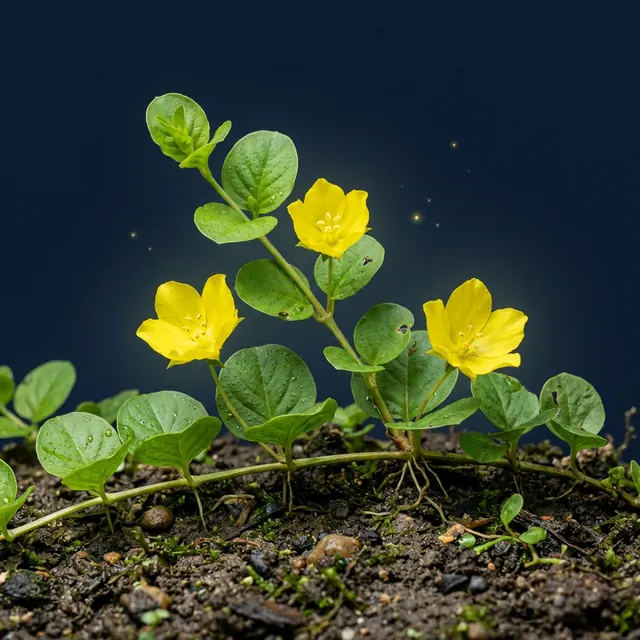
Creeping perennial forming mats up to 5 cm high, with shoots up to 60 cm long that root at the nodes. Leaves opposite, round like coins, entire, light green, with reddish dots. Flowers lemon-yellow, cup-shaped, up to 3 cm across, solitary or in pairs in the leaf axils, often spotted red inside.
Harvest
Gathered: herb (aerial parts).
When: June – August.
Form: infusion.
Lookalikes
- yellow pimpernel – leaves ovate and pointed, without dots, flowers smaller (under 1.5 cm); harmless
- biting stonecrop – also has yellow flowers close to the ground, but the leaves are thick, fleshy and tiny; poisonous
The information is educational and describes traditional use according to EMA/HMPC monographs (the European Medicines Agency and its Committee on Herbal Medicinal Products).It does not replace the advice of a doctor or pharmacist. Never eat a plant you are not 100% sure you recognise.