

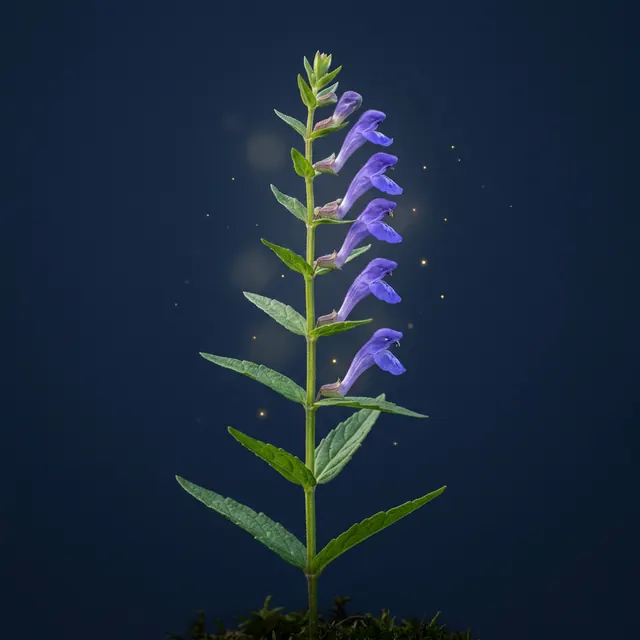
Common skullcap
Scutellaria galericulata L.
Traditional use
In Europe it is used instead of the American blue skullcap, whose herb is traditionally drunk as a mild sedative; both species have similar compounds. There is no EMA monograph or clinical studies for this species. Neo-clerodane diterpenes, among others, have been detected in the herb.
What it looks like
Perennial 15–40 cm tall, found by waters and in wet meadows, with a four-angled stem. Leaves opposite, oblong-lanceolate with a heart-shaped base, crenate. Flowers violet-blue, 1.2–2 cm, with a long, bent tube, in pairs in the leaf axils and all facing one way. Calyx with a characteristic small shield (scale) on its back.
Harvest
Gathered: herb (aerial parts).
When: June – August.
Form: infusion.
Lookalikes
- ground-ivy – also has blue-violet lipped flowers, but creeps and has round, scalloped leaves; harmless
The information is educational and describes traditional use according to EMA/HMPC monographs (the European Medicines Agency and its Committee on Herbal Medicinal Products).It does not replace the advice of a doctor or pharmacist. Never eat a plant you are not 100% sure you recognise.