

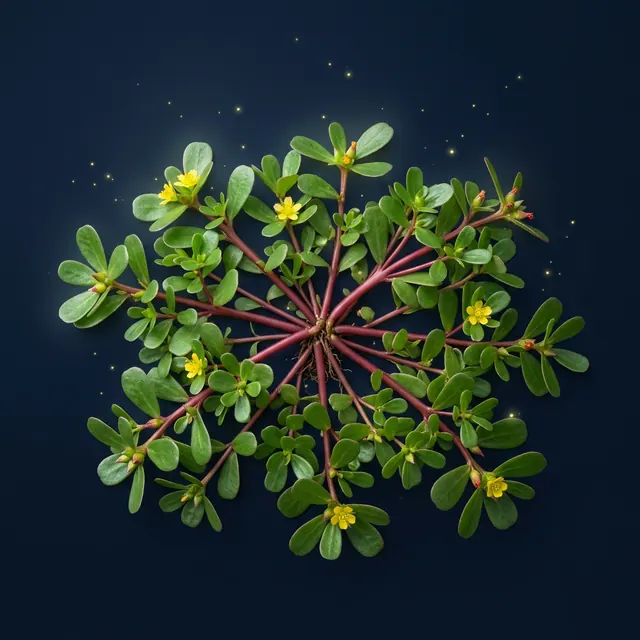
Common purslane
Portulaca oleracea L.
Polish folk names: portulaka warzywna
Traditional use
No EMA monograph. Purslane is an old vegetable, popular in Greek cuisine. It has juicy, slightly sour leaves, plenty of omega-3 fatty acids (0.2–0.38 g per 100 g), vitamins A and C, and calcium, iron, potassium and magnesium. It is regarded as a vegetable that supports digestion. Reviews of studies describe many effects in laboratory experiments, but there is no clinical evidence.
What it looks like
Annual, creeping plant of dry and sandy places. Stems hairless, succulent, often reddish, much-branched. Leaves fleshy, smooth, ovate or spoon-shaped, mostly opposite. Tiny yellow flowers with 5 petals open in the sun from July to September. The fruit is a capsule that opens with a lid, with black seeds.
Harvest
Gathered: young shoots and leaves.
When: June – September.
Form: kitchen (salads, like spinach, stems like asparagus).
Lookalikes
- Spotted spurge – a POISONOUS weed of town pavements and gardens, also creeping; shoots hairy, leaves small, serrated, with whitish stipules; purslane has bare, fleshy, smooth leaves
- Stonecrops – also have fleshy leaves, but usually cylindrical or densely arranged on the shoot; do not eat
The information is educational and describes traditional use according to EMA/HMPC monographs (the European Medicines Agency and its Committee on Herbal Medicinal Products).It does not replace the advice of a doctor or pharmacist. Never eat a plant you are not 100% sure you recognise.