

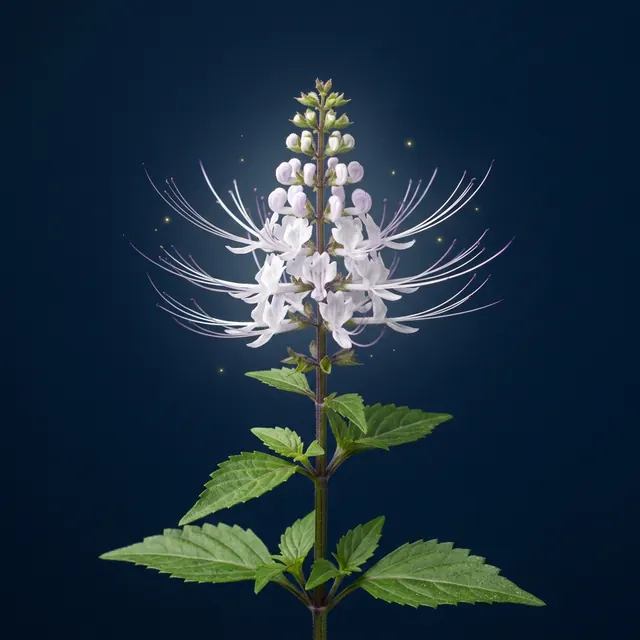
Java tea
Orthosiphon aristatus (Blume) Miq. (syn. Orthosiphon stamineus Benth.)
Polish folk names: herbata jawajska, koci wąs, liść ortosyfonu
Traditional use
Traditionally (EMA/HMPC) the leaf increases the amount of urine passed, which helps to flush the urinary tract. It is used as an aid in minor urinary tract complaints. In South-East Asia it is a popular herbal tea. Laboratory and animal studies describe diuretic and anti-inflammatory effects, but there are no strong clinical studies in humans. In Poland it is an imported raw material; the plant does not grow here.
What it looks like
Perennial herb or subshrub up to about 1.5 m with a four-angled stem. Leaves opposite, ovate, coarsely toothed. Flowers white or pale violet, lipped, in whorls forming terminal racemes. Very long, curved stamens protrude from the flowers, like cat's whiskers.
Harvest
Gathered: leaf.
Form: infusion.
Lookalikes
- Bought as a dried leaf at a pharmacy or herbal shop – in Poland there is no wild-growing lookalike
- Ornamental orthosiphons and other mint-family plants in pots – do not gather for tea without a sure identification
The information is educational and describes traditional use according to EMA/HMPC monographs (the European Medicines Agency and its Committee on Herbal Medicinal Products).It does not replace the advice of a doctor or pharmacist. Never eat a plant you are not 100% sure you recognise.