

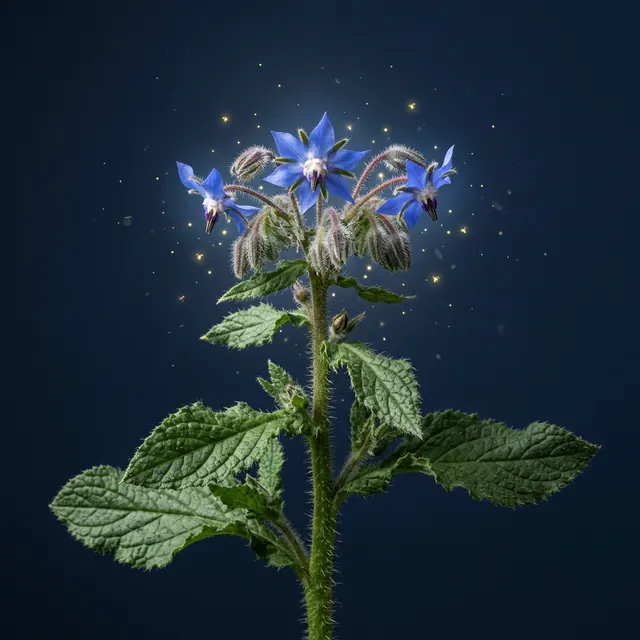
Borage
Borago officinalis L.
Polish folk names: ogórecznik
Traditional use
No EMA monograph. In folk medicine an infusion of the herb was used as a mild diuretic, anti-inflammatory and sedative, for irritation of the mucous membranes of the mouth, throat and stomach, and externally in compresses for slow-healing wounds, boils and acne. Seed oil is rich in gamma-linolenic acid. No strong clinical studies. The herb contains pyrrolizidine alkaloids, which can damage the liver; since July 2022 the European Union has limited their content in borage as food.
What it looks like
Annual up to 60 cm, covered all over in rough, spreading hairs, smells of fresh cucumber. Lower leaves large, elliptic, wrinkled; upper leaves clasp the stem. Flowers drooping, star-shaped, up to 3 cm across, with 5 pointed blue petals, white scales and a dark cone of stamens in the centre.
Harvest
Gathered: young leaves, flowers, seed oil.
When: June – August.
Form: kitchen (flowers and young leaves for salads), infusion, compress, seed oil (capsules).
Lookalikes
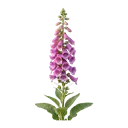
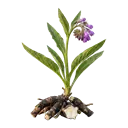
The information is educational and describes traditional use according to EMA/HMPC monographs (the European Medicines Agency and its Committee on Herbal Medicinal Products).It does not replace the advice of a doctor or pharmacist. Never eat a plant you are not 100% sure you recognise.