

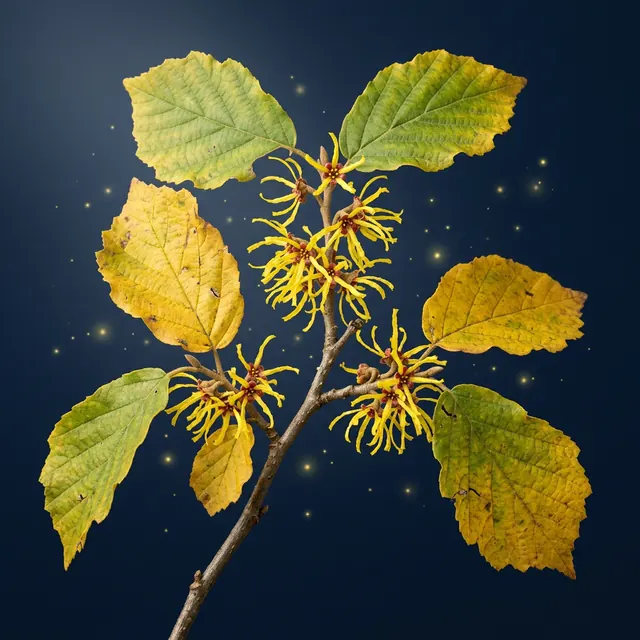
Witch hazel
Hamamelis virginiana L.
Polish folk names: hamamelis, woda oczarowa
Traditional use
Traditionally (EMA/HMPC): leaf and bark externally for minor inflammatory conditions and dryness of the skin, for itching and burning associated with haemorrhoids, and for rinsing the mouth in minor inflammations of the mucous membrane. The distillate (witch hazel water) also for temporary eye discomfort caused by dryness, wind or sun (in ready-made preparations). It contains a lot of tannins (hamamelitannins), which have an astringent effect. It comes from North America; in Poland it grows only in gardens.
What it looks like
Shrub or small tree up to 6 m, often with several trunks. Leaves broadly ovate, 4–16 cm, with a distinctly oblique base and a wavy-crenate margin, yellow in autumn. Flowers pale yellow, with 4 narrow, ribbon-like petals 1–2 cm long, appearing in autumn (October–November) as the leaves fall. The fruit is a woody capsule that shoots out black seeds.
Harvest
Gathered: leaf, bark, distillate of leaves and bark (witch hazel water).
When: June – August.
Form: rinse, compress, ointment, decoction.
Lookalikes
- hybrid witch hazel and Japanese witch hazel – garden witch hazels flowering in winter or early spring; they are not a pharmacopoeial raw material
- hazel – similar leaves, but without the thread-like yellow flowers in autumn
The information is educational and describes traditional use according to EMA/HMPC monographs (the European Medicines Agency and its Committee on Herbal Medicinal Products).It does not replace the advice of a doctor or pharmacist. Never eat a plant you are not 100% sure you recognise.