

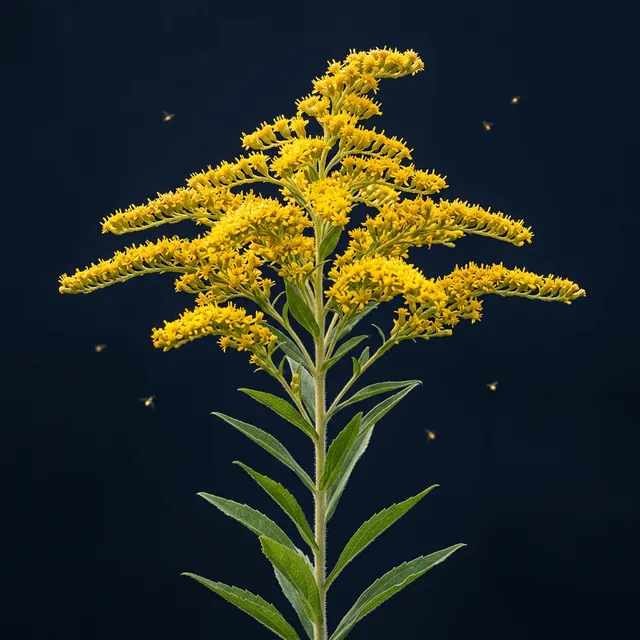
Canada goldenrod
Solidago canadensis L.
Polish folk names: złota rózga kanadyjska, nawłoć
Traditional use
The European Pharmacopoeia recognises the herb of Canada and giant goldenrod as a medicinal raw material. Traditionally it was used to increase urine output and flush the urinary tract. The European Medicines Agency monograph, however, covers only the native European goldenrod. It is also an important honey plant: goldenrod honey is golden and crystallises quickly.
What it looks like
A perennial 0.5–2 m tall in compact stands, with long rhizomes. Stem densely and shortly hairy, especially in the upper part. Leaves lanceolate, finely serrated, with three distinct veins. Small yellow flower heads in a large, broadly pyramidal panicle with arching branches, from August to October.
Harvest
Gathered: flowering herb.
When: August – September.
Form: infusion.
Lookalikes
- European goldenrod (Solidago virgaurea) – native, low, with a narrow, upright cluster of flowers
- late goldenrod (giant goldenrod) – stem bare and bluish, not hairy like the Canada goldenrod
- common ragwort – also yellow, but with larger flower heads in a flat umbel-like cluster, and strongly poisonous to the liver
The information is educational and describes traditional use according to EMA/HMPC monographs (the European Medicines Agency and its Committee on Herbal Medicinal Products).It does not replace the advice of a doctor or pharmacist. Never eat a plant you are not 100% sure you recognise.