

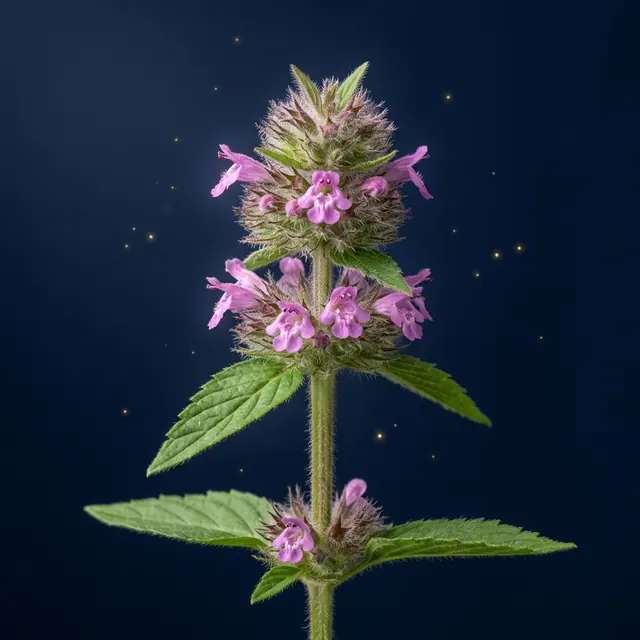
Wild basil
Clinopodium vulgare L.
Polish folk names: czyścica storzyszek, storzyszek pospolity
Traditional use
In folk medicine the herb (Herba Clinopodii) was used to speed up the healing of wounds, and an infusion for poor digestion. The extract is bactericidal in laboratory studies. Young leaves are edible raw and cooked, and are used as a seasoning and for an aromatic tea. There is no EMA monograph, and there are no clinical studies.
What it looks like
Softly hairy perennial 30–60 cm tall with a four-angled stem. Leaves opposite, ovate, pointed, short-stalked. Purple two-lipped flowers 12–15 mm in dense, globular whorls in the leaf axils, surrounded by bristly, hairy bracts, which makes the whorls look like fluffy balls.
Harvest
Gathered: herb (aerial parts), young leaves.
When: July – September.
Form: infusion, compress, spice.
Lookalikes
- oregano – smaller flowers in corymbs, not in whorls; harmless
- wild thymes – low, small-leaved; harmless
The information is educational and describes traditional use according to EMA/HMPC monographs (the European Medicines Agency and its Committee on Herbal Medicinal Products).It does not replace the advice of a doctor or pharmacist. Never eat a plant you are not 100% sure you recognise.