

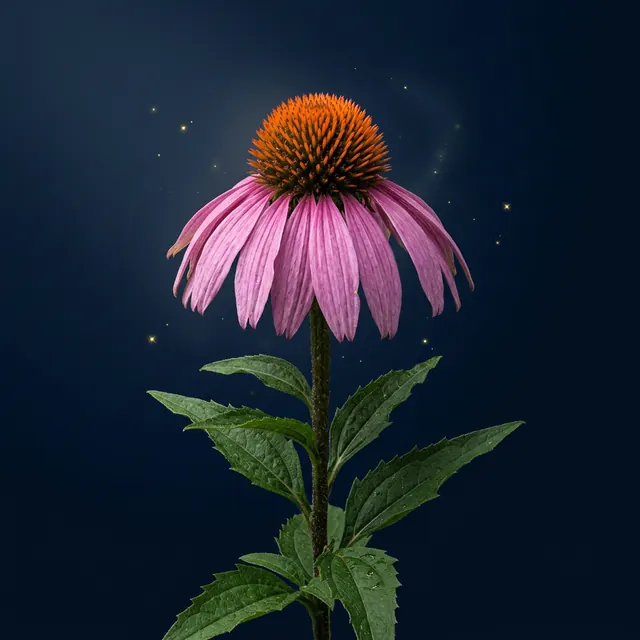
Purple coneflower
Echinacea purpurea (L.) Moench
Polish folk names: echinacea
Traditional use
According to the EMA/HMPC, juice from the fresh herb taken orally briefly prevents and treats colds (well-established use). Traditionally (EMA/HMPC) the herb on the skin - for small, superficial wounds; the root - for cold symptoms and mild acne. Cochrane review (2014): at most a weak benefit, of doubtful clinical significance.
What it looks like
Perennial 60–150 cm tall, cultivated in Poland. Leaves ovate to lanceolate, irregularly toothed, rough. Large flower heads: purple-pink ray florets 4–6 cm long, drooping downwards, and a domed, spiny, orange-brown centre of sharp receptacle bracts.
Harvest
Gathered: herb (fresh, flowering), root.
When: July – September.
Form: juice from the fresh herb (preparations), ointment.
Lookalikes
- Rudbeckia (coneflowers) - yellow ray florets and a dark centre; harmless
- other coneflowers (pale purple, narrow-leaved) - narrower, paler ray florets; harmless
The information is educational and describes traditional use according to EMA/HMPC monographs (the European Medicines Agency and its Committee on Herbal Medicinal Products).It does not replace the advice of a doctor or pharmacist. Never eat a plant you are not 100% sure you recognise.