

Roselle - hibiscus
Hibiscus sabdariffa L.
Polish folk names: hibiskus, ketmia
Traditional use
No EMA monograph. It does not grow in Poland - the dried, red calyces are bought as "hibiscus" tea, popular in Arab countries and Africa. The raw material has a sour taste from organic acids (the Polish Pharmacopoeia requires at least 13.5% acids as citric acid). Meta-analyses of clinical studies show that regularly drinking the infusion lowers systolic blood pressure, most in people with raised blood pressure, and slightly improves cholesterol levels. The certainty of these results was rated at best as moderate; it does not replace medicines.
What it looks like
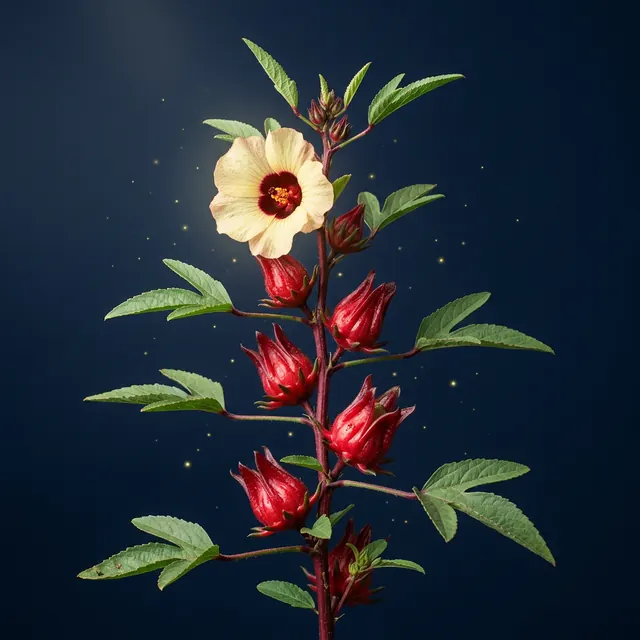
Tropical plant up to 3 m tall with a reddish stem that turns woody at the base and palmately lobed leaves. Flowers creamy yellow with a dark centre. After flowering, the calyx swells into a fleshy, bright red or purple, urn-shaped “fruit” with 5 pointed sepals and a ring of 8–12 narrow bracteoles at the base.
Harvest
Gathered: calyx with epicalyx (dried, bought).
Form: infusion (hot or cold), syrup, kitchen.
Lookalikes
- Rose of Sharon (garden hibiscus) - a shrub planted in Poland for its large flowers; it is not a tea raw material
- In the shop: "fruit" blends coloured with hibiscus - check the ingredients
The information is educational and describes traditional use according to EMA/HMPC monographs (the European Medicines Agency and its Committee on Herbal Medicinal Products).It does not replace the advice of a doctor or pharmacist. Never eat a plant you are not 100% sure you recognise.