

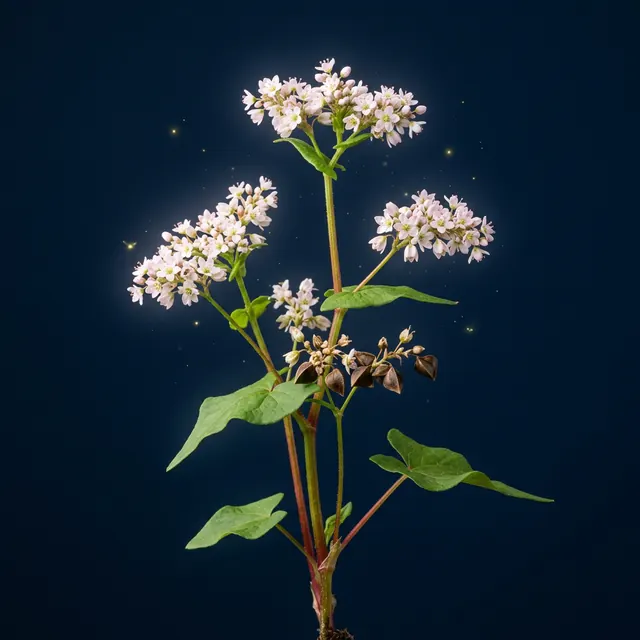
Common buckwheat
Fagopyrum esculentum Moench
Polish folk names: tatarka, hreczka, poganka, gryka siewna
Traditional use
The seeds give buckwheat groats and flour – valuable protein, gluten-free. Buckwheat herb (Fagopyri herba) was a raw material for obtaining rutin (min. 3%); in herbalism it was used to strengthen capillaries, for varicose veins and nosebleeds, but these uses have no good clinical studies. No EMA monograph was found. Buckwheat is an important honey plant.
What it looks like
Annual plant, 30–80 cm, with a reddish, hollow stem. Leaves heart-arrow-shaped, up to 11 cm, with membranous sheaths (ocreae) at the base. Small, fragrant flowers, white to pink, in dense corymb-like clusters from the leaf axils. The fruit is a brown, three-angled achene (nutlet) resembling a miniature beechnut.
Harvest
Gathered: herb (at the start of flowering), seeds (groats, flour).
When: July – September.
Form: herb infusion, groats/kitchen, buckwheat honey.
Lookalikes
- black bindweed (Fallopia convolvulus) – a wild weed with similar arrow-shaped leaves, but twining and with inconspicuous flowers
- redshank (Persicaria maculosa) – pink spikes, lanceolate leaves with a dark blotch
The information is educational and describes traditional use according to EMA/HMPC monographs (the European Medicines Agency and its Committee on Herbal Medicinal Products).It does not replace the advice of a doctor or pharmacist. Never eat a plant you are not 100% sure you recognise.