

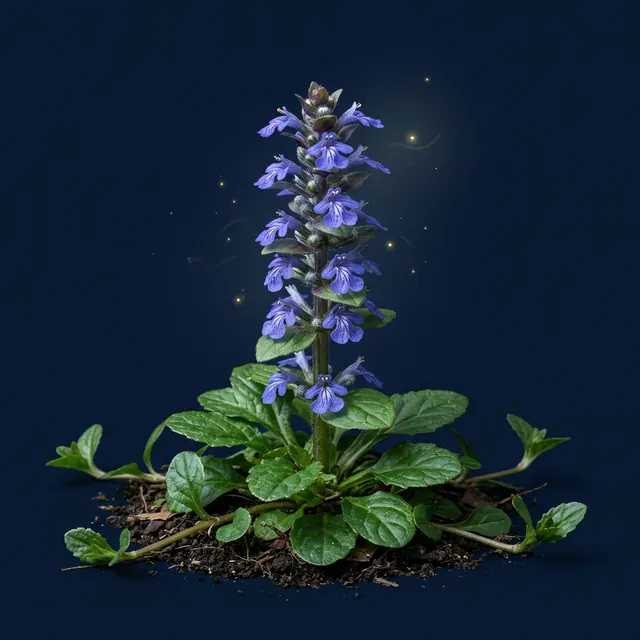
Bugle
Ajuga reptans L.
Traditional use
No EMA monograph. Formerly regarded as a medicinal plant, today forgotten in that role; in Austrian folk medicine a tea from the herb was drunk for respiratory complaints. Studies are exclusively laboratory and animal studies. Young leaves and flowers are sometimes eaten.
What it looks like
Low perennial 15–30 cm tall in deciduous forests and meadows, forming carpets thanks to creeping, rooting runners. Leaves in a rosette, obovate, entire or shallowly crenate. Stem square, hairy on two opposite sides. Blue-violet lipped flowers in false whorls form a spike; the lower lip is large and three-lobed, the upper one very short.
Harvest
Gathered: herb (aerial parts), young leaves, flowers.
When: April – June.
Form: infusion, kitchen (young leaves, flowers).
Lookalikes
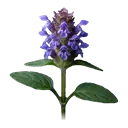
- self-heal - flowers in a compact, cylindrical head, without above-ground runners; harmless
- ground-ivy - creeping, roundish kidney-shaped leaves, flowers in the leaf axils; harmless
The information is educational and describes traditional use according to EMA/HMPC monographs (the European Medicines Agency and its Committee on Herbal Medicinal Products).It does not replace the advice of a doctor or pharmacist. Never eat a plant you are not 100% sure you recognise.