

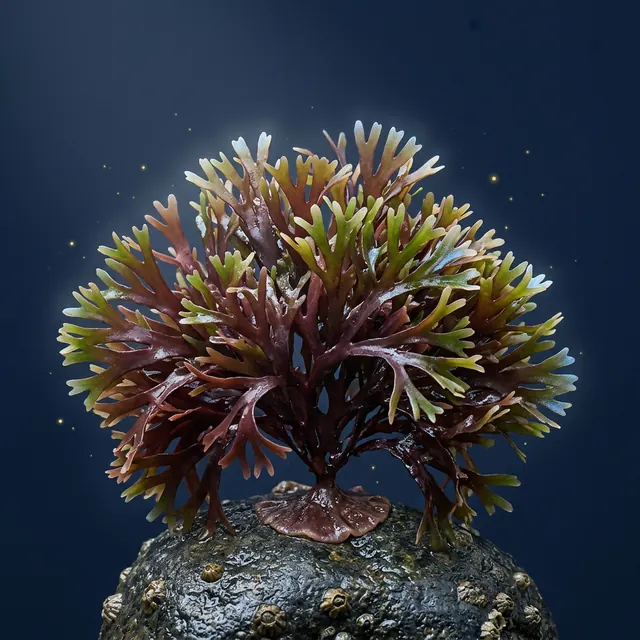
Irish moss
Chondrus crispus Stackh.
Polish folk names: mech irlandzki, karagen, Carrageen
Traditional use
It is not a plant, but a red alga (red seaweed) from the Atlantic coasts of Europe and North America. When cooked it gives a jelly: in Ireland and Scotland a milk pudding is made from it. In old books the mucilaginous decoction was given for cough and to the weakened. It is a raw material for producing carrageenan (additive E 407), used as a thickener. A 2024 review collects many effects in the laboratory and in animals, but clinical studies are few. No EMA monograph.
What it looks like
Low, bushy marine alga up to about 20 cm, attached to rocks by a disc-shaped holdfast. Thallus cartilaginous, flat, branching 4–5 times in a forked, fan-like way, segments 2–15 mm wide. Colour from yellow-green near the water surface to dark red and purplish-brown deeper down; the tips are sometimes bluish and iridescent. When dried it is whitish-yellow and brittle.
Harvest
Gathered: thallus (whole dried alga).
Form: decoction (jelly), kitchen (pudding).
Lookalikes
- Mastocarpus stellatus – a similar red alga, the thallus clearly channelled and twisted; harvested together with Irish moss
- Iceland moss – a terrestrial lichen, also an old mucilaginous remedy for cough
The information is educational and describes traditional use according to EMA/HMPC monographs (the European Medicines Agency and its Committee on Herbal Medicinal Products).It does not replace the advice of a doctor or pharmacist. Never eat a plant you are not 100% sure you recognise.