

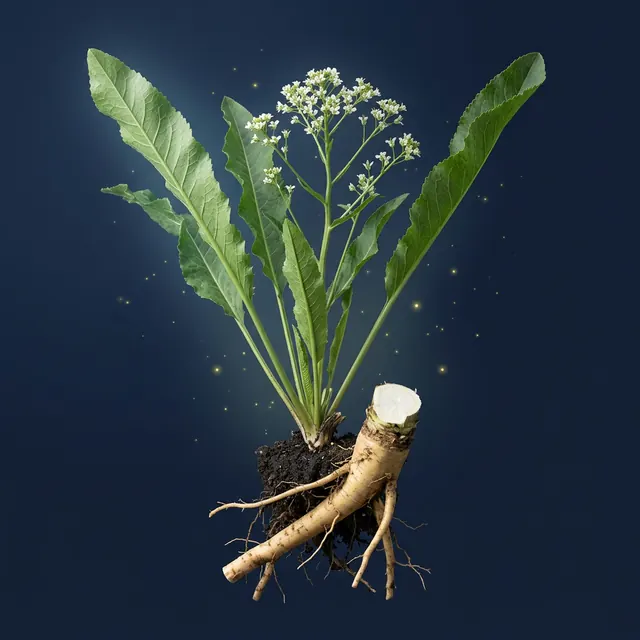
Horseradish
Armoracia rusticana G.Gaertn., B.Mey. & Scherb.
Polish folk names: chrzan, warzęcha, warzucha
Traditional use
No EMA monograph. In folk medicine, horseradish was used internally for cough and bronchitis, chronic catarrh, poor digestion and rheumatism, and poultices of freshly grated root were applied for rheumatic pains and neuralgia (they irritate and warm). The root contains the glycoside sinigrin, from which, once grated, a sharp mustard oil forms that is antibacterial in studies. At Easter, horseradish goes into the blessed Easter basket. There is no clinical evidence of a medicinal effect.
What it looks like
Perennial 40–150 cm tall with a thick, long, pale yellow root, white in cross-section, with a very sharp smell. Basal leaves huge, up to 1 m, oblong-ovate, crenate, on long stalks. Stem leaves pinnately divided or narrow. In May and June, panicles of tiny white 4-petalled flowers.
Harvest
Gathered: root, young leaves.
When: March, April, October, November.
Form: kitchen (freshly grated root), poultice (briefly), syrup with honey.
Lookalikes
- Broad-leaved dock and burdock – also have large basal leaves, but the root, when cut, does not smell sharp; do not dig up roots of plants you do not know
- Roots of other wild perennials (including very poisonous ones) – you recognise horseradish by its white break and its sharp, eye-watering smell once grated
The information is educational and describes traditional use according to EMA/HMPC monographs (the European Medicines Agency and its Committee on Herbal Medicinal Products).It does not replace the advice of a doctor or pharmacist. Never eat a plant you are not 100% sure you recognise.