

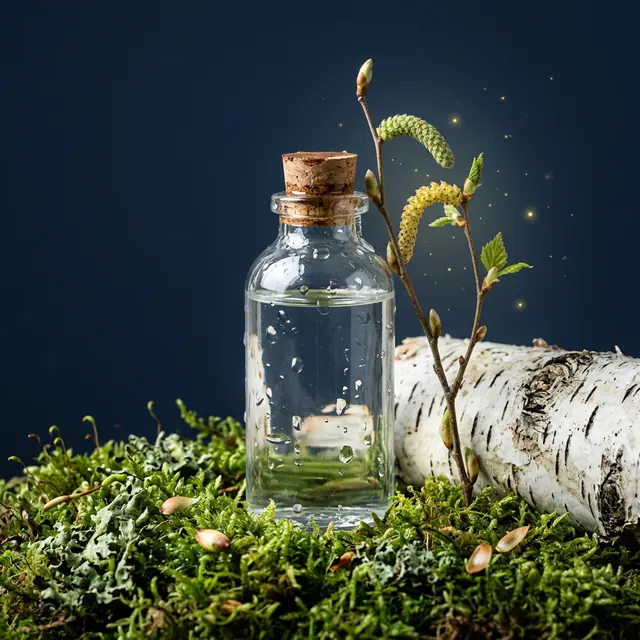
Birch sap
Betula pendula Roth, Betula pubescens Ehrh. (sok)
Polish folk names: oskoła, sok brzozowy, woda brzozowa
Traditional use
No EMA monograph. In Poland and throughout the Slavic lands, as well as in Lithuania, Latvia, Estonia and Finland, it was drunk in spring as a refreshing drink and a “spring cure”. It is almost entirely water (98–99%) with a little sugar (mainly fructose and glucose, about 1%), organic acids and mineral salts (potassium, calcium, magnesium, manganese). It tastes mild and slightly sweet. There are no clinical studies confirming a medicinal effect, so treat it as a drink, not a medicine.
When the sap flows
Roughly from mid-March to the end of April, for 2–4 weeks. The sap flows when nights are still cool or frosty and days are warm, before the birch leafs out. When the buds burst and leaves appear, the sap turns cloudy and bitter. That is the end of the season.
How to collect without harming the tree
- Choose a healthy tree with a trunk thicker than 20 cm. Leave thinner ones alone.
- Drill one thin hole with an 8–10 mm bit, 2–4 cm deep, about half a metre to a metre above the ground, angled slightly upward so the sap runs out on its own.
- Push a clean tube (food-grade hose or a wooden tap) into the hole and lead it into a bottle. Cover the container so insects don't fall in.
- Collect from one tree for no more than a few days, and only from one hole (from a very thick one, from two at most).
- At the end, remove the tube and plug the hole firmly with a wooden peg, preferably from a birch twig. This keeps fungi and bacteria out of the wound.
- Never hack the bark with an axe, cut around the trunk or strip the bark. A large wound is a gateway for fungi that can kill the tree.
What the law says
- State forest: the Forest Act prohibits damaging trees, so you may collect sap only with the forest district's permission. Ask at the nearest forest district; sometimes they point out trees designated for felling.
- Your own plot or forest: you may, they are your trees.
- Someone else's plot, a park, a tree by the road: only with the owner's permission (in a city park, that is the municipality).
- National parks and nature reserves: not allowed.
How to store
- Collect into clean, scalded bottles and chill right away.
- At room temperature the sap spoils after just a day; in the fridge it lasts about 5–6 days.
- For longer, freeze it in bottles or pasteurise it in jars. Leave some room in a freezing bottle, because ice expands.
- The sap is also used to make birch kvass (with sugar, lemon and raisins or yeast) and birch syrup.
Curiosities
- Oskoła is the old Polish name for birch sap.
- A drink made from birch oskoła from the Zławieś Wielka municipality (Kuyavian-Pomeranian Voivodeship) has been on the List of Traditional Products since 2025. Mentions of it date back to the 19th century.
- A large birch can yield even a dozen or so litres of sap a day. In spring the roots push the sap upward, because the tree has no leaves yet to draw water.
- For 1 litre of birch syrup you need to boil down about 100 litres of sap, more than twice as much as for maple syrup.
- Maples also give spring sap. The most famous is Canadian maple syrup.
What it looks like
A clear, watery liquid with a delicately sweetish, “woody” taste. It flows in spring from silver birch and downy birch, i.e. trees with white bark with black fissures. Towards the end of the season, when the buds burst, it turns cloudy and slightly bitter.
Harvest
Gathered: sap (oskoła).
When: March – April.
Form: fresh sap for drinking, kwas brzozowy, syrop brzozowy.
The information is educational and describes traditional use according to EMA/HMPC monographs (the European Medicines Agency and its Committee on Herbal Medicinal Products).It does not replace the advice of a doctor or pharmacist. Never eat a plant you are not 100% sure you recognise.