

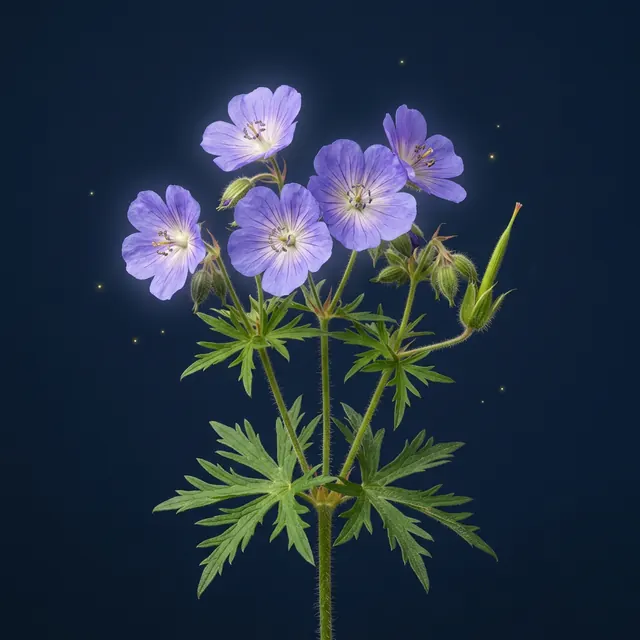
Meadow cranesbill
Geranium pratense L.
Traditional use
In folk medicine the herb was regarded as medicinal and used as an astringent, because of its tannins and ellagic and gallic acids. There is no EMA monograph or clinical studies. Today it is valued mainly as a honey plant and an ornamental.
What it looks like
Perennial up to 80 cm with glandular-hairy stems. Leaves kidney-shaped, palmately cut almost to the base into 7 narrow, incised segments. Flowers in pairs at the tips of the shoots, up to 3 cm across, with 5 ovate blue-violet petals. Fruit with a long beak that flings out the seeds.
Harvest
Gathered: herb (aerial parts).
When: June – August.
Form: infusion.
Lookalikes
- monkshood (wolfsbane) – also has blue-violet flowers and palmate leaves, but the flowers are hooded, in a raceme, not flat and 5-petalled; deadly poisonous
- wood cranesbill – flowers more red-violet, grows in mountain forests; harmless
The information is educational and describes traditional use according to EMA/HMPC monographs (the European Medicines Agency and its Committee on Herbal Medicinal Products).It does not replace the advice of a doctor or pharmacist. Never eat a plant you are not 100% sure you recognise.